
In 1956, Queen Elizabeth II opened Calder Hall. Britain had built the world’s first full-scale commercial nuclear plant.1 In the next decade, Britain built ten more. By 1966, Britain produced more nuclear electricity than every other country combined.2 Even as the US and the Soviet Union caught up, Britain remained a top three nuclear generator well into the 1970s.3
Britain has generated more than 3,000 TWh of nuclear electricity since Calder Hall opened— enough to meet every UK household’s electricity use for almost 40 years, or to run the London Underground for more than two millennia.4 5
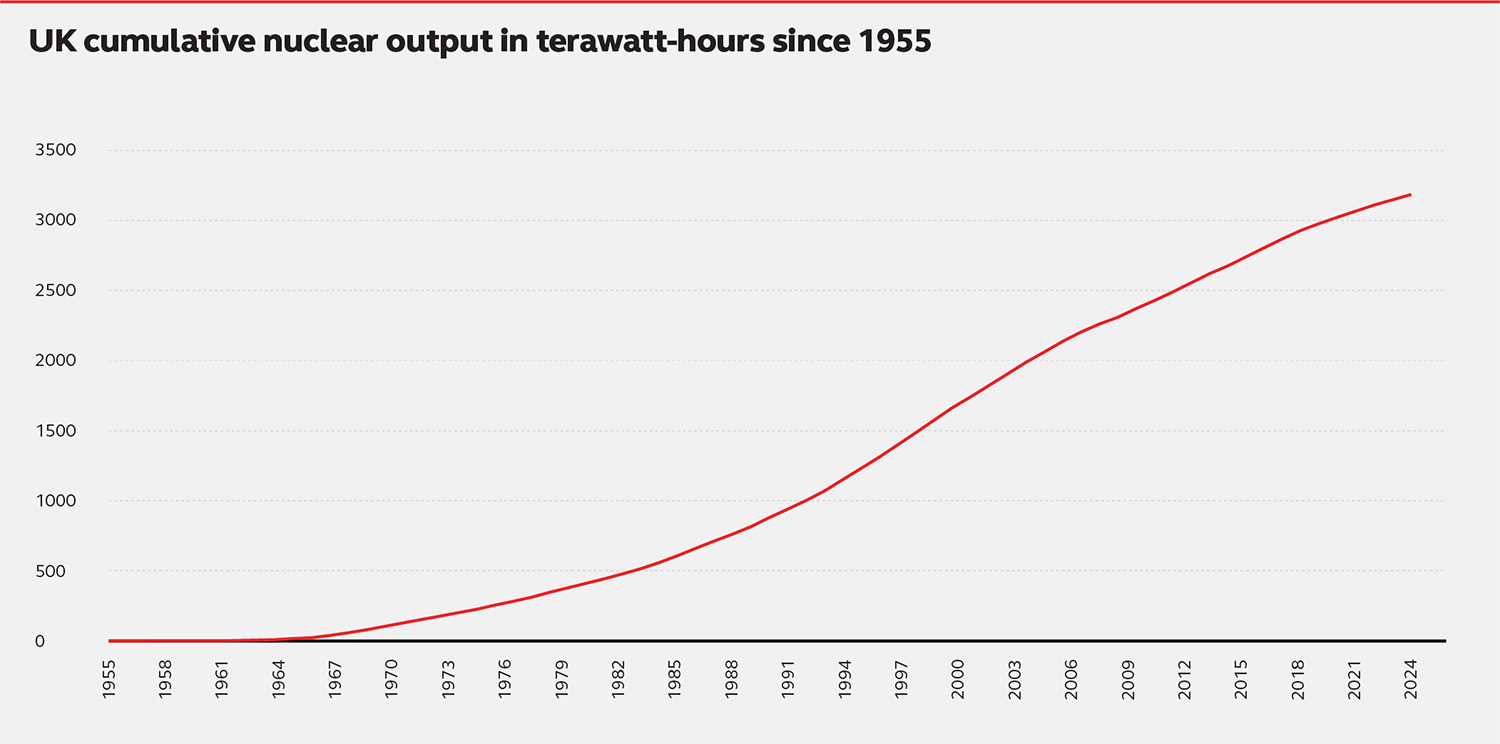
Nuclear electricity operates with virtually no carbon emissions. If coal had generated that electricity instead, more than 3,000 megatonnes of CO₂ would have entered the atmosphere—about 27 years’ worth of exhaust from every car, van, lorry, train, and bus in Britain combined.6 Without clean nuclear power taking the place of dirty coal, 75,000 people would have died early from conditions like asthma and lung cancer.
Across the world, nuclear has produced more than 100,000 TWh since the 1960s—preventing about 2.5 million deaths and 82 gigatonnes of CO₂ compared with coal—roughly the emissions from burning 390,000 tanker‑loads of liquefied natural gas.
For nuclear communities like Whitehaven (Sellafield), Caithness (Dounreay) and East Lothian (Torness), nuclear means thousands of good jobs. Cumbria’s nuclear cluster anchors high-quality jobs: at Sellafield, average pay tops £43,000 and the site underpins about 60% of Copeland’s GVA and jobs.7 Nuclear jobs not only pay well, they are secure too. When nuclear plants close after decades of operation and new ones are blocked or delayed, the impact is painful. On Anglesey/Ynys Môn, median full-time pay at island workplaces fell by 14% between 2016 and 2019 when Wylfa closed and plans for a new nuclear power station on the island fell through.8
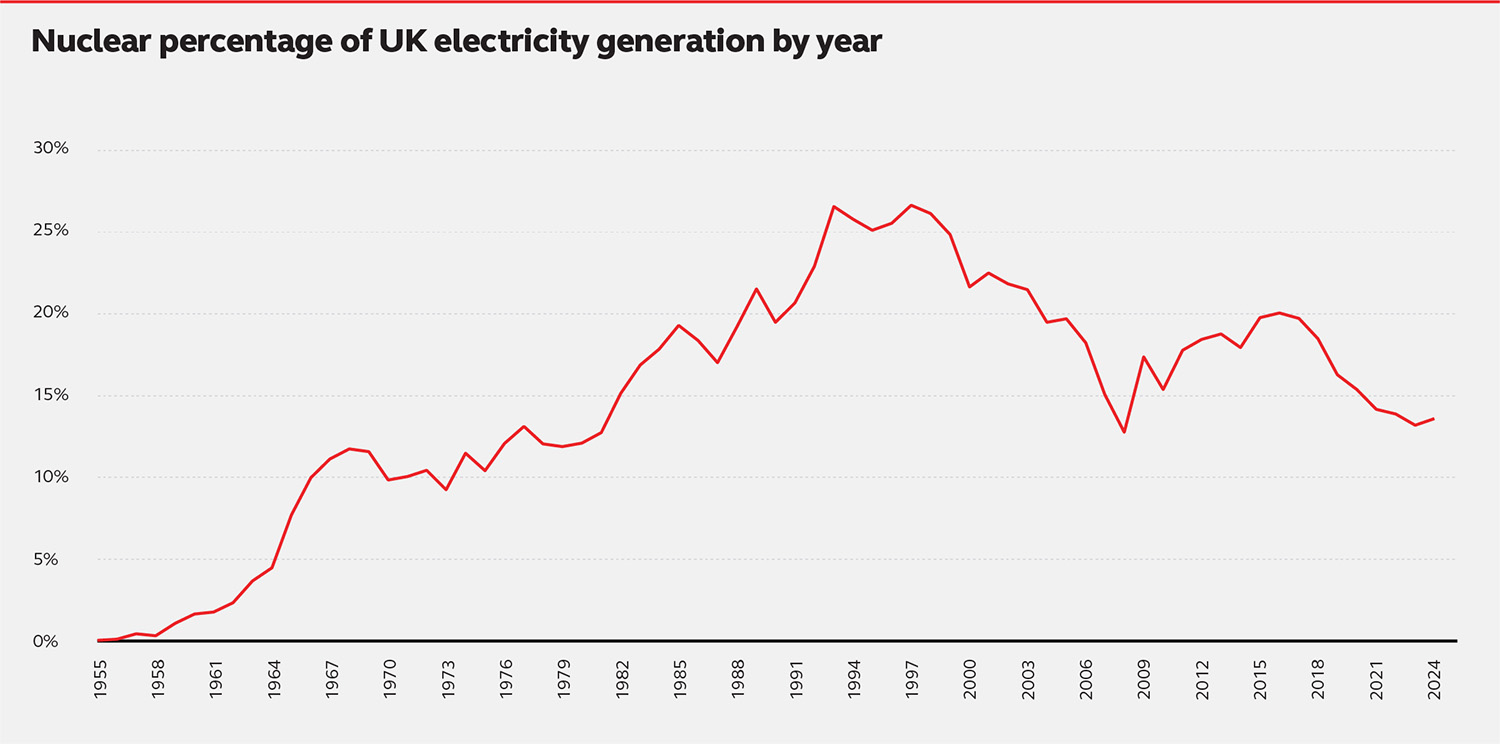
Source: DESNZ - Electricity Since 1920
Britain is building again
Britain used to generate over a quarter of its power needs through nuclear. Today we produce just 14% this way.9 It has been three decades since Britain last built a new nuclear power station. In that time, more than 6.2 GW of nuclear capacity – plants like Hinkley Point A and B, Dungeness A and B and Calder Hall – entered defuelling and decommissioning. There was a realistic prospect that before this decade’s end, whole months would have passed without a single watt of nuclear power being produced in Britain. For the first time in 66 years, the sun would have temporarily set on British nuclear power. This was avoided by a last-minute stay of execution for Torness and Heysham B – a life extension that Britain Remade campaigned for.10
When Russia’s invasion of Ukraine caused gas prices to spike, British households were left exposed. Energy bills reached eye-watering levels, and would have gone even higher had the Government not borrowed billions to fund the Energy Price Guarantee. Brits looked at the French grid with envy.
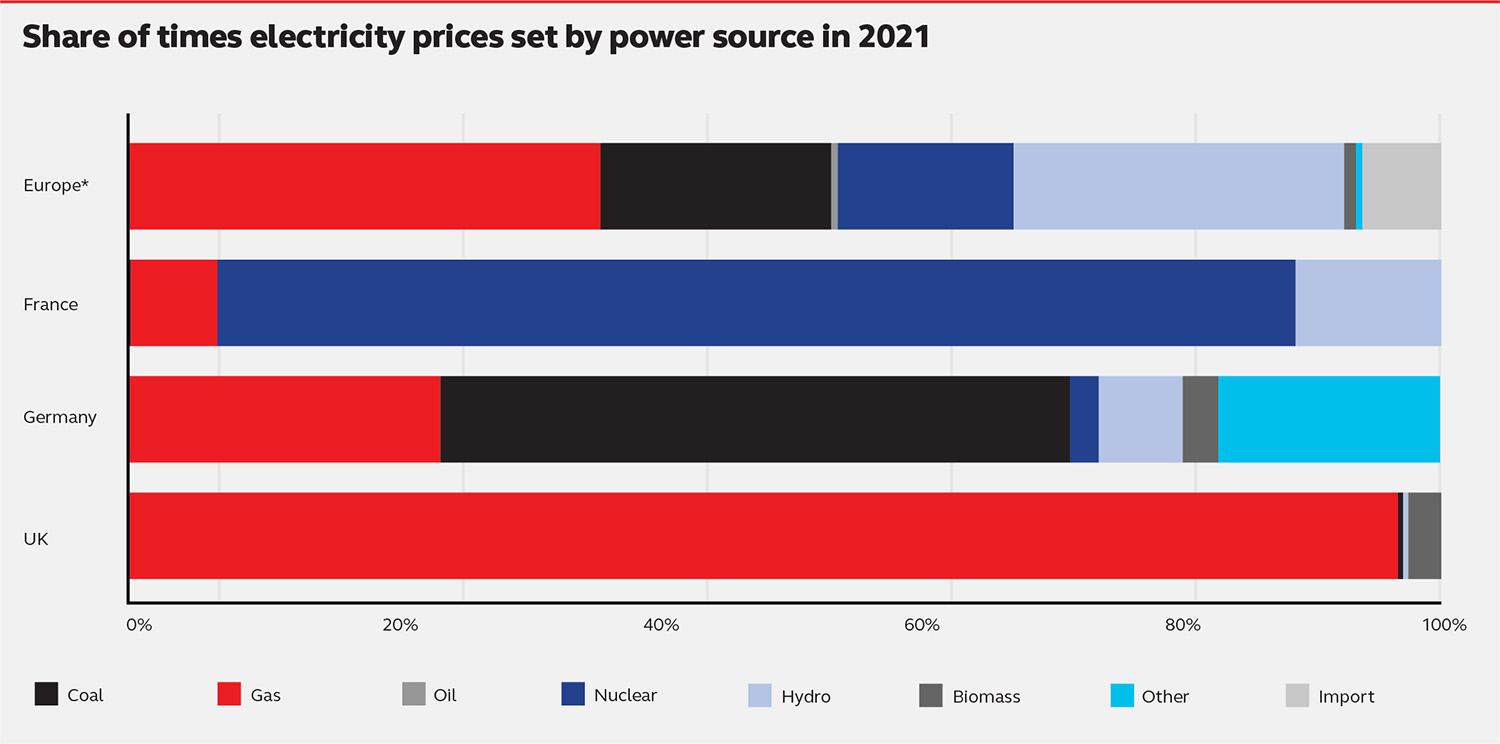
French billpayers pay less because they are less exposed to high gas prices. Gas generates 6% of France’s electricity and sets the price 7% of the time (versus 98% in Britain). In France, nuclear sets the price 80% of the time.11
Britain is now building new nuclear plants again. Hinkley Point C in South-West England has been under construction for nearly seven years –after a decade in planning– and is expected to generate power from 2029. Construction on Sizewell C in the East of England is underway too. When complete, each will produce enough power for six million homes, 13 million electric vehicles, or eight million heat pumps for at least 60 years. The Government is in negotiations with Rolls-Royce SMR to build a fleet of small modular reactors. In South Wales, Last Energy has entered the site-licensing process to build a micro-SMR to power data centres.12 The Secretary of State for Energy Security, Ed Miliband, has declared “a golden age” for nuclear power.13
Yet to meet climate goals, cut bills, and seize the opportunity of AI, Britain will need to bring new nuclear onto the grid at a speed and scale not seen since the 1960s. That will only happen if Britain solves one problem: cost.
Britain is the most expensive place to build a nuclear power station in the world
Britain is an expensive place to build new infrastructure such as trams, road tunnels, and railways. When Britain Remade reviewed over 242 infrastructure projects across 14 countries built in the last three decades, we found that in almost all areas of infrastructure Britain was a high-cost country: either the most expensive country in the world or in the top three alongside the US and Canada.
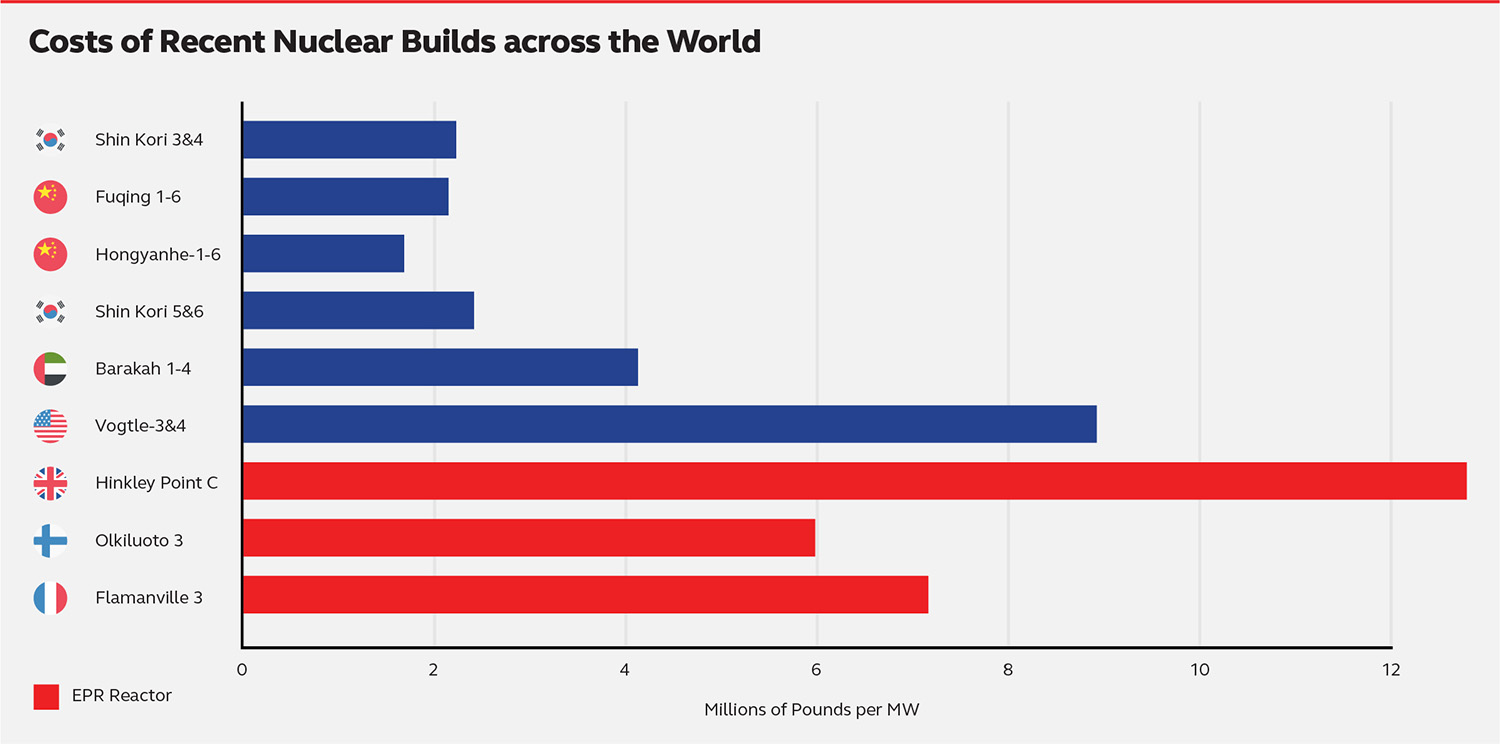
When we reviewed every single nuclear project built since the year 2000, Britain topped the table for cost per kilowatt capacity. Hinkley Point C is estimated to cost £46 billion, or £14,100 per KW of capacity. When finished, it will be the most expensive nuclear power station built in the history of the world. To put that into perspective, the next most expensive nuclear project – the two new AP-1000 reactors at Vogtle in Atlanta – cost 12% less. Vogtle’s $36.8 billion (£27.4 billion) cost was the result of almost everything that could go wrong going wrong. In the process of construction, its designer and initial project manager Westinghouse filed for bankruptcy, regulators insisted on major design changes extremely late in the project’s development, and there were multiple large construction errors that led to work being redone at great expense.
Vogtle and, to some extent, Hinkley Point C were both ‘first-of-a-kind’ reactors. Building a completely new design from scratch is inherently risky. Expensive mistakes are simply a cost of doing business. In general—“learning by doing” applies far beyond nuclear—costs fall as the second, third, and fourth reactors are built. Sizewell C, which uses the same reactor design as HPC, is still estimated to cost £38bn.14 This is cheaper than Hinkley Point C, but still slightly more expensive than Vogtle when adjusted for inflation.
In the 1950s and 1960s, Britain stood out as the world leader in nuclear energy. France took that crown in the 1970s and 1980s when they responded to the oil crisis by opening 57 reactors in 19 years. Today, the country people look to for nuclear energy is South Korea, where since 1983 Korea’s national nuclear energy company KEPCO has built 27 plants in 42 years with three more under construction.
South Korean nuclear plants are built at about one-sixth the cost of Hinkley Point C. If Britain was able to build at South Korean costs, we could have procured enough nuclear capacity to power 36 million homes for the cost of Hinkley Point C.
South Korea’s KEPCO has even built reactors abroad for far less than the cost of Hinkley. The Barakah power station in the UAE—despite no prior nuclear build and major geographic constraints—came in about 70% lower per MW than Hinkley Point C.
Part of the gap reflects Britain’s choice of design. But as well as choosing a more complicated design, we have implemented it more expensively than other countries. France and Finland have built—or are building—European Pressurised Reactors, the same core design as Hinkley Point C. Yet France’s Flamanville 3 cost about 27% less than HPC, while Finland’s Olkiluoto 3 came in at about half the cost.
Flamanville 3 was plagued by construction problems. Work had to be redone multiple times because it did not meet standard. Early concrete pours were too wet. Steel reinforcements did not match the blueprints. Welds that should have been neat, continuous seams showed defects and had to be redone, including around pipe penetrations. For safety-critical systems, patching is not an option. Entire sections had to be cut out, redone, and tested extensively. Despite this, Flamanville 3 still cost about a quarter less than Hinkley Point C.
Historically, Britain has often delivered nuclear projects at far lower costs than today, even though they were generally more expensive than those built by our international competitors. The last nuclear reactor completed in the UK, Sizewell B, is the nation’s only pressurised water reactor (PWR), a design deployed 95 times in the US. Built in 1995 at a cost of £6,200 per kW of capacity, Sizewell B still cost less than half of Sizewell C’s projected outturn, assuming the latter is on budget.15
Britain’s first generation of nuclear plants, the Magnox stations built from the late 1950s to the late 1970s, were also substantially cheaper than those currently under construction. Many cost less than half of Sizewell C; even the most expensive Magnox with reliable data—Trawsfynydd—was marginally cheaper.16
The second wave—the advanced gas‑cooled reactors (AGRs)—had a mixed legacy. The Central Electricity Generating Board backed the ambitious British design. They promised refuelling without shutdown, improving load factors. But there was no prototype. The engineering was complex, and each station was unique, which prevented modular construction. These factors drove up costs and led to overruns. Even so, several AGRs (such as Torness, Hinkley Point B, and Heysham 2) are expected to produce electricity at roughly half the lifetime cost per unit of Hinkley Point C. With the exception of Dungeness B, which closed seven years earlier than planned, all AGRs will be cheaper over their lifetimes than Hinkley Point C.17
Britain needs nuclear
Britain needs to end its reliance on expensive dirty gas for three key reasons.
- Burning imported gas is expensive: Britain’s industrial energy costs are the highest in the developed world and almost twice the European average. High costs are shrinking energy‑intensive sectors such as chemicals, plastics, and steel. They also deter investment in power‑hungry data centres and risk the UK falling behind in AI.
- Burning imported gas leaves us exposed to shocks abroad: Russia’s invasion of Ukraine sent gas prices soaring. The average dual-fuel energy bill jumped by 235%. As long as Brits rely on gas to power and heat their homes, British households face large price rises whenever conflict breaks thousands of miles from our shores.
- Burning imported gas causes climate change: Britain has a legally-binding target to reach net zero greenhouse gas emission by 2050. Put simply, Britain cannot meet that target if it continues to burn gas to power and heat our homes. If temperatures rise above 1.5°C, the IPCC forecasts more flash floods, the loss of up to 90% of warm‑water coral reefs, and millions at risk of hunger from crop failures.
Britain cannot end its reliance on imported gas with intermittent renewables alone.
In the last decade and a half, Britain has added an enormous quantity of wind (offshore) and solar to the grid. By adding all of this clean power to the grid, Britain, the country that birthed the industrial revolution, was able to close all of its coal plants. Over that time as the world installed more and more, renewables got much cheaper. The Levelised Cost of Energy (LCOE), which takes into account the costs of building, operating, and maintaining energy infrastructure, has fallen massively for renewables. The cost of building wind farms in Britain has fallen by over a third onshore and over half offshore since 2015.18 Large scale solar costs fell by nearly a third between 2013 and 2021 in Britain and by even more internationally.19 Renewables are playing an extremely important role in Britain’s decarbonisation.
Yet while renewables are part of the answer, they are not the full answer.
The key problem is intermittency. Wind and solar produce power only when the wind is blowing and the sun is shining. Batteries can smooth daily peaks and troughs. The real challenges come in the longer-term, between weeks, months, or seasons. When Britain goes weeks without sufficient sun or wind, keeping the lights on will typically force us to rely on a flexible ‘dispatchable’ form of generation. In practice, that means gas. Britain could and should do more to invest in longer duration energy storage such as pumped hydro, compressed air, and hydrogen, but all of these technologies face major constraints. Some face geographic limits; all face cost constraints.
LCOE is useful for tracking wind and solar’s cost declines, but the metric is limited for a grid where most power comes from renewables, for four reasons.
- You still need the same backup. Britain’s grid is put under the greatest strain during cold, dark winter evenings. If the wind isn’t blowing, then there’s no alternative but to rely on a flexible back-up: gas. As wind and solar take a bigger role on the grid, gas plants run for fewer hours. This saves on fuel, but the cost of keeping a gas plant in working order stays the same. Spreading that big fixed bill over increasingly few hours of generation pushes average costs up.
- The grid needs to balance and that gets more expensive as you introduce more variable generation. More wind and solar makes the job of managing the grid more complicated. A sudden surge in wind can leave the grid’s control room scrambling to get assets to turn off. Curtailment payments—last‑minute pay‑to‑switch‑off orders—are high and rising. The reverse can happen too. When the wind isn’t blowing as much as we expected: heavy energy users are paid to switch off. All of this can get expensive – balancing costs were £2.7 billion last year.20
- You have to overbuild to survive the worst weeks. To almost entirely drive gas off the grid the focus must be on the worst winter lulls, not the average day. In other words, you need to build more than you need for the average day and then store the excess for the lean weeks. The result is paying to build infrastructure that won’t be used to its full capacity most of the time.
- Wind (and to a lesser extent solar) will be constrained without major upgrades to the grid. Britain’s wind resource isn’t evenly distributed around Britain. It is concentrated in Scotland and the East of England. That’s a problem because Britain’s population (and energy demand) is concentrated in the South East. A failure to invest in the grid has left wind farms north of the border unable to send their power down south to where the demand is. Due to our single national electricity market, Scottish wind farms are often paid millions to switch off when the grid is constrained. The National Grid is spending billions upgrading transmission networks to lower these costs.
In other words, even if wind and solar are ‘cheap’ on average, they can still be ‘expensive’ at high penetrations.
Two further reasons make it unlikely that intermittent renewables can meet our needs alone.
AI is power-hungry 24/7. Ever since ChatGPT launched, major tech companies have scrambled to build data centres. In November 2022 NESO estimated that data centres would consume 5TWh of electricity by 2030.21 Two years later, that was revised to 22TWh. In Ireland, just under one quarter of all power generated goes to powering data centres. Ireland has recently announced a de facto moratorium on new data centre projects until 2028 to allow the grid to catch up.22 In other words, banning growth-boosting investments because of a lack of power. Crucially, data centres are ‘always on’. They demand the same level of power around the clock. Unlike other forms of demand that can be flexed (e.g. charging an EV at night, heat pumps powering when electricity is cheap), AI data centres cannot be turned off without making them dramatically more expensive to run. If Britain does not build the clean infrastructure to power data centres, expect them to go to dirtier grids with abundant energy. The US Department of Energy forecasts that American data centres could demand 580TWh by 2028 – nearly twice the UK’s total electricity demand.23
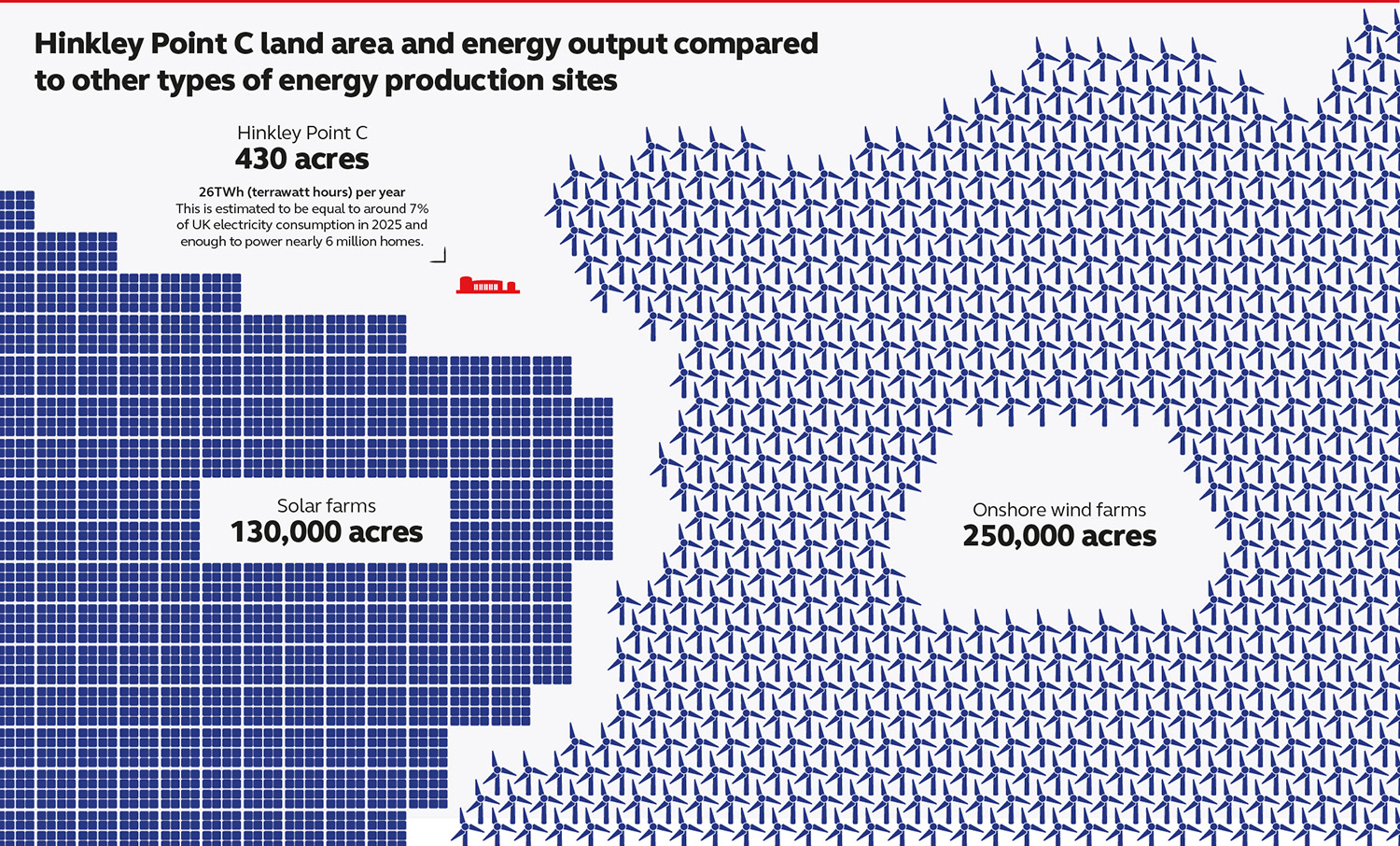
Land. Britain needs to expand its electricity generation massively to meet demand from the electrification of heating and transport. Decarbonising dirty industrial processes by using new technologies, such as making steel with electric-arc furnaces, will mean using more electricity in practice. Adding all of that to unexpectedly large demand from data centres will create genuine land pressures. Although the UK’s 70 GW solar target could use just 0.46% of British land, going further—especially with over‑building—will be challenging. Expect conflicts over land between farming, renewables, and nature recovery. Nuclear, by contrast, is the densest form of power ever invented. To match Hinkley Point C’s annual electricity output, Britain would need a solar farm larger than the Isle of Wight.24
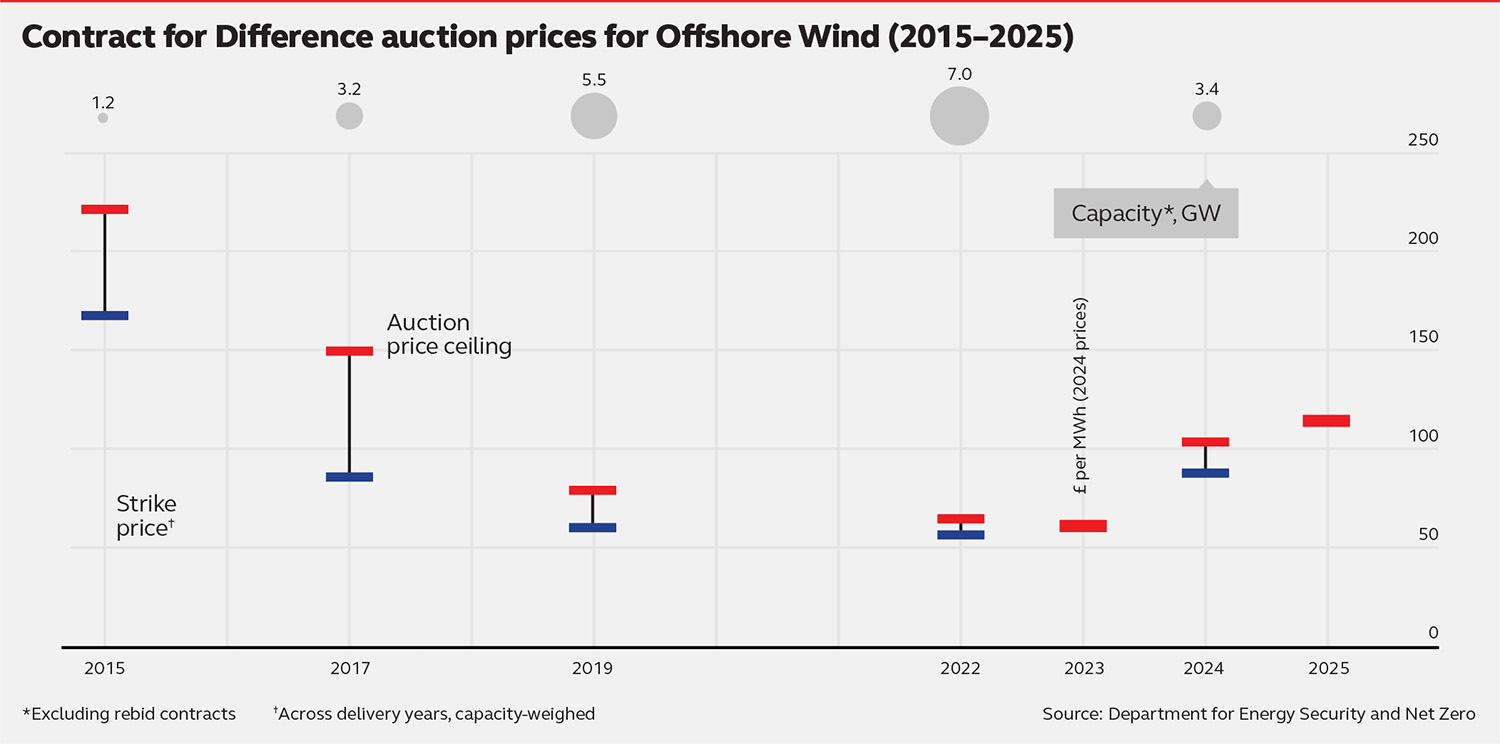
Renewables have seen large cost decreases over the past decade and a half. Solar, in particular, has seen massive declines. The International Energy Agency has consistently under‑estimated global solar uptake. In fact, they’ve undershot it almost every year since the forecast began in 2002.25 Wind costs have fallen too, the Contract for Difference (CfD) auction in 2022 came in at £66.28 for solar and £53.82 for offshore wind (both in 2025 prices).26
The auction that followed in 2023 didn’t clear at all for offshore wind. The Government responded by setting a higher strike price (maximum bid) for the next auction in 2024. It did clear, but the offshore wind price came in well above what it was in 2019 and roughly the same as it did in 2017.27 Offshore wind at these prices costs slightly more than gas currently does. In other words, offshore wind CfDs may help us avoid 2022-style gas price spikes, but they won’t bring bills down from their current unacceptably high levels.
Recent allocation rounds may be a temporary blip. Higher interest rates have raised financing costs for renewable developers. Offshore wind in particular has been hit by a global capacity crunch. Installing offshore wind farms requires specialised vessels. As the world turns to renewables, key inputs are in short supply. Big investments in ports, such as deeper docks and bigger cranes, will have an upfront cost but should lower prices over time. Yet we should be prepared for renewables to cost more than expected. Recent events show it is a mistake to assume costs will always fall.
Why we need to make nuclear cheap again
If renewables costs fail to fall in the years ahead, or worse, rise, then Britain faces major problems. At the moment, the public blame high energy bills on Russia and our reliance on gas, but if Britain cuts gas to just 5% of total power generation and bills remain high, support for climate action is likely to wane. The 2030s will be a critical decade for decarbonisation. If Britain is to meet its legally binding climate targets, it must be a decade of electrification. Families up and down Britain will need to go from heating their homes with gas boilers to heating them with heat pumps. Motorists will need to swap their petrol cars for electric vehicles.
If electric heating costs more than gas, then families won’t do it. If charging an electric car is not much cheaper than petrol, then motorists will not make the switch. More than anything, the pace of decarbonisation in the 2030s will be set by the price of electricity.
If Britain’s industrial electricity prices stay high, then jobs in energy-intensive industries will continue to be lost. At the same time, new AI jobs will go elsewhere as high power costs deter investment.
Nuclear power can bring down Britain’s electricity bills dramatically, but only if building gets cheaper.
Hinkley Point C and Sizewell C are critical low-carbon investments in Britain’s energy system. They do not just cut emissions; they provide firm, always-on power that reduces the need for backup gas plants, oversized renewable fleets, and additional grid infrastructure. Sizewell C’s official Value for Money Assessment estimated that building the plant would save UK consumers £2 billion per year compared to meeting the same need with more wind.
However, modelling commissioned by Britain Remade shows that building another nuclear plant in addition to Hinkley Point C and Sizewell C, at the same price as Hinkley Point C would actually increase bills by £6 per household, assuming energy costs above DESNZ’s baseline scenario.28
DESNZ baselines do assume that solar costs will fall by 27% by 2040 and wind by around 6%. While this is within the range of possibilities, the results for allocation rounds for solar have been similar for many years and wind costs have recently been rising. Therefore we have also modelled if renewables costs rose above the DESNZ baseline by 30%. Even then though, a new plant at Hinkley Point C’s cost would still make bills go up.
If we were able to get costs down to Korean or even French levels building an additional large nuclear plant like Hinkley Point C would cut bills even if Renewables cost perform as well as DESNZ expects. At French cost levels it saves over £4 billion over the 25 years to 2050 for bill payers; at Korean costs, nearly £6billion. At these prices for renewables, building eight more nuclear plants at Korean prices would save £8.9 billion over 25 years.
If renewables costs rise 30% above baseline, building fifteen new plants at Korean prices would be optimal, saving bill payers nearly £21 billion over 25 years. Even at French prices, the most cost‑efficient plan would be to build eight new plants, saving bill payers nearly £7.6 billion over 25 years. PWR plants are built to last at least 60 years, so it is likely these plants would be driving down bills for decades more.