
 Media
MediaForty five leading figures from academia, business and politics tell Ed Miliband "Don't U-turn" on the commitment to implement every recommendation of the Fingleton Nuclear Regulatory Review.
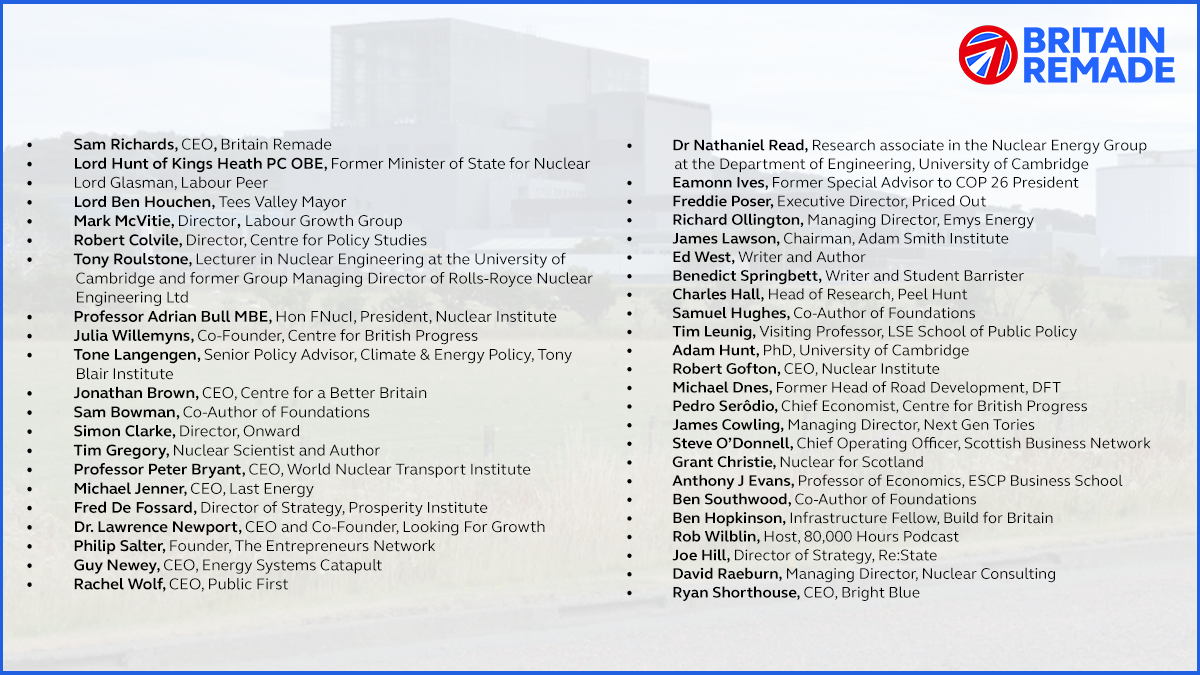
Full text of the letter, addressed to Ed Miliband, and list of signatories:
Dear Secretary of State,
We are writing to you in support of the full and timely implementation of John Fingleton’s recent independent Nuclear Regulatory Review.
Britain is the most expensive place in the world to build new nuclear power. Bringing these costs down is essential if we want to create jobs, tackle climate change, and cut energy bills. The Fingleton review contains 47 serious recommendations that, if adopted in full, would help achieve this goal.
While we welcome the Prime Minister’s strategic steer which accepts “the principle of all the recommendations” of the review, we are deeply concerned that the government’s implementation plan will U-turn on some of these recommendations.
Some nature NGOs have now begun to campaign against recommendations 11, 12, and 19 of the review. These reforms would:
• Remove the costly requirement for like-for-like on-site environmental mitigation (11)
• Create a streamlined alternative pathway for compliance with the habitats regulation that would unlock significant funding for nature recovery (12)
• Remove the vague National Park Duty introduced by the Levelling Up and Regeneration Act 2023 (19)
A recent briefing note from the Wildlife Trusts argues that the review is “based on flawed evidence” and that “implementing the Nuclear Regulatory [Taskforce’s] recommendations would devastate nature without speeding up the nuclear planning and delivery process.”
There’s just one big problem: many of the claims made by the Wildlife Trusts in their note are inaccurate, misleading, or frankly irrelevant. We enclose a detailed rebuttal with this letter.
We note that the Wildlife Trusts do not dispute the real friction introduced by the current regime. To win planning approval at Hinkley Point C, EDF was compelled to submit over 30,000 pages of environmental documentation; face three unsuccessful environmental legal challenges; delay essential works at a cost of £150m due to a failed court action; install unprecedented (and costly) mitigation systems; and apply for planning permission for operational minutiae with no safety or visual impact. These are exactly the sorts of issues the Fingleton Review seeks to resolve.
If the government is serious about growing the economy, reducing bills, and delivering a new golden age of nuclear energy, its implementation plan must back the Fingleton reforms in full. In particular it is essential that the government proceeds with recommendations 11, 12 and 19.
The stakes here are high. Nuclear energy is the most land-efficient zero-carbon technology we possess. A single power station can power millions of homes. If we are serious about halting climate-driven nature loss, then nuclear energy must expand in a safe, secure and sustainable way. Yet that will not happen unless costs fall significantly. We cannot afford for the government to U-turn on accepting all of the recommendations of the Fingleton Review.
Signed,
• Sam Richards, CEO, Britain Remade
• Lord Hunt of Kings Heath PC OBE, Former Minister of State for Nuclear
• Lord Glasman, Labour Peer
• Lord Ben Houchen, Tees Valley Mayor
• Mark McVitie, Director, Labour Growth Group
• Robert Colvile, Director, Centre for Policy Studies
• Tony Roulstone, Lecturer in Nuclear Engineering at the University of Cambridge and former Group Managing Director of Rolls-Royce Nuclear Engineering Ltd
• Professor Adrian Bull MBE, Hon FNucI, President, Nuclear Institute
• Julia Willemyns, Co-Founder, Centre for British Progress
• Tone Langengen, Senior Policy Advisor, Climate & Energy Policy, Tony Blair Institute
• Jonathan Brown, CEO, Centre for a Better Britain
• Sam Bowman, Co-Author of Foundations
• Simon Clarke, Director, Onward
• Tim Gregory, Nuclear Scientist and Author
• Professor Peter Bryant, CEO, World Nuclear Transport Institute
• Michael Jenner, CEO, Last Energy
• Fred De Fossard, Director of Strategy, Prosperity Institute
• Lawrence Newport, CEO and Co-Founder, Looking For Growth
• Philip Salter, Founder, The Entrepreneurs Network
• Guy Newey, CEO, Energy Systems Catapult
• Rachel Wolf, CEO, Public First
• Dr Nathaniel Read, Research associate in the Nuclear Energy Group at the Department of Engineering, University of Cambridge
• Eamonn Ives, Former Special Advisor to COP 26 President
• Freddie Poser, Executive Director, Priced Out
• Richard Ollington, Managing Director, Emys Energy
• James Lawson, Chairman, Adam Smith Institute
• Ed West, Writer and Author
• Benedict Springbett, Writer and Student Barrister
• Charles Hall, Head of Research, Peel Hunt
• Samuel Hughes, Co-Author of Foundations
• Tim Leunig, Visiting Professor, LSE School of Public Policy
• Adam Hunt, PhD, University of Cambridge
• Robert Gofton, CEO, Nuclear Institute
• Michael Dnes, Former Head of Road Development, DFT
• Pedro Serôdio, Chief Economist, Centre for British Progress
• James Cowling, Managing Director, Next Gen Tories
• Steve O’Donnell, Chief Operating Officer, Scottish Business Network
• Grant Christie, Nuclear for Scotland
• Anthony J Evans, Professor of Economics, ESCP Business School
• Ben Southwood, Co-Author of Foundations
• Ben Hopkinson, Infrastructure Fellow, Build for Britain
• Rob Wilblin, Host, 80,000 Hours Podcast
• Joe Hill, Director of Strategy, Re:State
• David Raeburn, Managing Director, Nuclear Consulting
• Ryan Shorthouse, CEO, Bright Blue