
A policy playbook for cheaper nuclear
Sam Dumitriu
Michael Hill
Contents
- Executive Summary
- Full List of Recommendations
- Introduction
- Why Nuclear Is More Expensive To Build In Britain
- Regulating Radiation
- Planning and Environmental Permitting
- Unlocking Private Investment For SMRs
- Conclusion
- Endorsements
- Acknowledgements
- References
Executive Summary
Britain is the most expensive place in the world to build new nuclear power stations
Britain Remade has reviewed every nuclear project built since 2000: Britain is the most expensive place to build per kilowatt (kW) of capacity.
Hinkley Point C is estimated to cost £46 billion, or £14,100 per kW: when finished, it will be the most expensive nuclear power station ever built.
British-built plants cost far more per kW than peers: our per-kW costs are about six times South Korea’s, and France and Finland deliver the same EPR design for less per kW (27% and 53% respectively).
Britain has gone backwards on cost: Sizewell B in 1995 cost £6,200 per kW, less than half Sizewell C’s budgeted cost.
Britain cannot end its reliance on gas with renewables alone
Britain needs to end reliance on expensive, unstable, high-carbon gas: it is costly, exposes us to global shocks, and drives climate change.
Renewables may have seen large price-falls over the last 15 years but at high penetrations costs linked to managing intermittency are high: Britain has added 40 GW since 2010 and 120 GW is forecast by 2030, yet balancing, curtailment, backup, and overbuild still add cost and leave gaps that require firm power.
The most important technology of the 21st Century is AI: it will generate a large increase in baseload energy demand that wind and solar are ill-suited to meeting without substantial overbuilding.
Britain needs cheaper nuclear
Britain Remade have modelling tested different nuclear build costs and renewable price scenarios to assess long-term impacts on household energy bills: at Hinkley Point C’s current costs, another large nuclear plant would raise bills by about £6 per household, even if renewables costs rose 30% above government forecasts.
At French or Korean build costs, new large nuclear plants would cut bills: this would save £4–6 billion over 25 years for a single plant, and more with multiple builds.
If renewable costs rise, nuclear can play an even larger role: government forecasts assume falling solar costs (-27% by 2040) and modest wind cost drops (-6%), but recent data show solar prices flat and wind costs rising. If renewables costs climb 30% above baseline, the most cost-efficient plan would be eight new plants at French prices (saving £7.6 billion) or fifteen at Korean prices (saving £21 billion) over 25 years, with benefits lasting decades.
Britain’s high nuclear costs are driven by multiple factors
Slow, resource-intensive consultation, planning, and permitting: Sizewell C’s planning process involved seven consultations, an 80,000-page environmental impact assessment, and multiple legal challenges before construction could begin.
Over-specification driven by political demands and gold-plated regulation: Hinkley Point C made thousands of design changes to meet environmental and safety rules, including unique features like a fish-return system and acoustic fish deterrent.
Stop-and-start approach to construction: with no new nuclear plants built in three decades, Hinkley Point C had to rebuild supply chains from scratch; when construction began, there was only one nuclear-qualified welder in the UK.
Lack of standardisation and frequent design changes: unlike its French and Finnish counterparts, Hinkley Point C includes extra safety systems such as a separate analogue control system, additional diesel backup, and an extra spent-fuel-pool cooling train.
Regulation acts as a barrier to cost-reducing best practices
Limiting gains from learning across projects: Frequent design changes and site-specific mitigations disrupt standardisation, undermining the cost savings seen when building multiple identical plants; for example, welding at Hinkley Point C’s second reactor is four times faster than at the first, yielding an estimated 30% saving.
Making it harder to innovate in reactor design and construction: Safety case requirements and planning rules slow adoption of proven improvements; Hinkley Point C needed extra planning approval to change its waste-storage method.
Deterring investment in supply chains: Stop-start construction and uncertainty discourage spending on specialist skills and equipment, reducing the benefits of fleet builds; for example, foreign welders were hired instead of training new British ones.
Creating barriers to entry for disruptive competition: Lengthy, expensive licensing and planning processes make it harder for new entrants to challenge incumbents with lower-cost or innovative designs.
Increasing the risk associated with financing fleets: The fleet model depends on early, settled decisions, but planning delays or forced design changes can make multi-plant financing unviable.
Preventing the use of modular construction: Added safety and environmental features, like hard-wired backup control and instrumentation systems, increase design complexity and reduce the ability to use cost-saving factory-built modules.
Safety regulation is disproportionate to the risks of radiation
Nuclear is one of the safest energy technologies: Per unit of electricity, it is as safe as wind or solar and between 100 to 1,000 times safer than fossil fuels. Deaths due to nuclear accidents are extremely rare. Chernobyl is estimated to have caused only around 200 premature deaths, with none from other civil nuclear accidents such as Fukushima and Three Mile Island.
Radiation is natural and nuclear power is not the main source: Average Britons receive about 2 mSv/year from natural background radiation, rising to around 7 mSv/year in Cornwall due to high radon levels. Coal plants and rare-earth mining for renewables expose people to more radiation than living near a nuclear plant.
Risks are low in practice: The highest-exposed person near Hinkley Point receives just 0.32 mSv/year (two chest x-rays, or 320 g of Brazil nuts), and even in a worst-case core meltdown at Hinkley Point C, modern safety systems would limit public exposure to a few mSv—less than half a year’s natural background in Cornwall.
Britain regulates radiological risk under Health and Safety Law: The key principle is ‘As Low as Reasonably Practicable’, or ALARP. Below legal limits (1 mSv/year in normal operation) dutyholders are required to reduce risks until further measures would be grossly disproportionate. ALARP is not intended to require constant improvement, yet in practice requires design changes (or at least safety cases) covering extremely low levels of radiation exposure.
The UK applies a goal-based rather than prescriptive system: Nuclear site licence holders are free to choose how they meet safety goals, which allows flexibility and innovation. Yet the open-ended nature of ALARP creates uncertainty, often pushing operators to go beyond what the law requires, adding costly safety measures that provide little additional benefit.
The UK’s application of ALARP drives costly add-ons to cut already tiny risks: Independent economic analysis of the Office for Nuclear Regulation’s (ONR) practices found that cost-benefit analysis is almost never used to challenge design-change requests.
Dutyholders rarely contest recommendations because challenge is costly and slow: Preparing safety cases and gross-disproportion analyses takes months and can only be done by expensive specialist teams. Timelines are uncertain and repeated challenges risk harming a licensee’s perceived safety culture. All of this is undertaken knowing there is a substantial risk the ONR will reject the analysis.
Nuclear regulation does not use a default method to calculate gross disproportion: ratios vary by context, with the Sizewell B Inquiry using three for worker risk, two for low public risk, and ten for high-consequence risks. Quantified costs are often weighed against qualitative safety claims and wider benefits are excluded. Unlike the US’s Nuclear Regulatory Commission and the National Institute for Health and Care Excellence (NICE), the ONR does not use a standard “value of life” estimate to quantify costs.
To be ALARP, dutyholders must use Relevant Good Practice (RGP): RGP covers guidance, standards, and practices with a safe operating record, but there is no clear hierarchy. This ambiguity leads to frequent redesigns of proven foreign reactors. For the EPR, it led to thousands of UK-specific changes, including a separate analogue control system and two additional HVAC floors. More steel, concrete, and cabling were required as a result.
RGP has forced expensive modifications on modern designs with little-or-no safety benefit: to meet ONR requirements, GE Hitachi was required to modify the ABWR design by installing bulky HEPA filters on each HVAC duct even though they reduced radiation exposure by only 0.0001 mSv—equivalent to eating a single banana.
Inflexible planning and permitting processes hold back green nuclear power
Nuclear is low-carbon across its life cycle: Producing zero in operation and, even counting mining and construction, on average fewer carbon emissions than wind and solar. Nuclear, wind, and solar all emit about one-twentieth of the carbon emissions of gas per watt generated. Coal emits sixty times more carbon per watt generated than nuclear.
Nuclear’s fuel density keeps waste tiny: A uranium pellet can power a home for two years and a lifetime household’s electricity use in Britain would produce less than a shot glass worth of waste. All of the UK’s nuclear waste to date and all the waste for the next 100 years would fit in a building the size of Wembley.
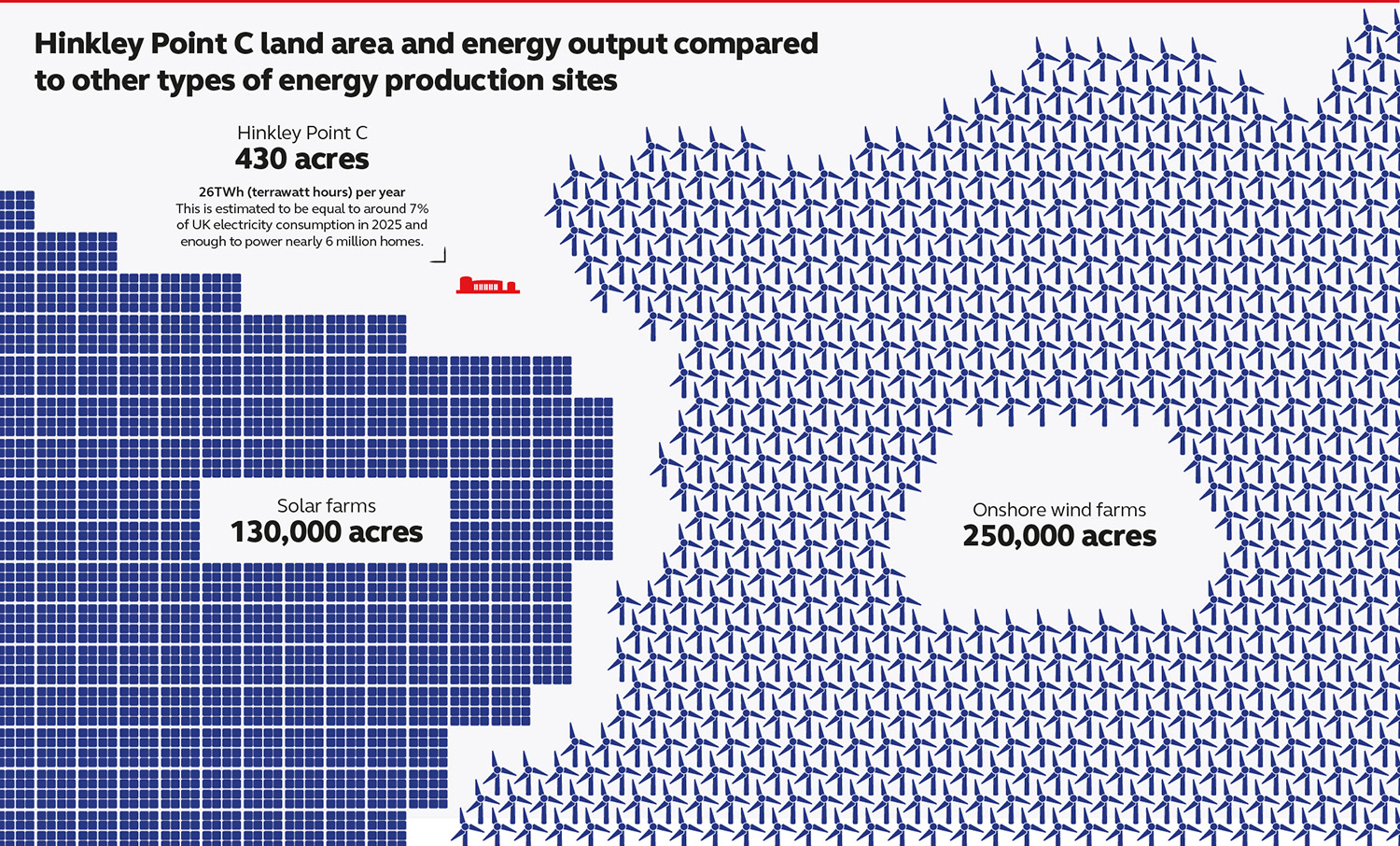
Nuclear minimises land use and can support wildlife: To match Hinkley Point C’s annual output would require a solar farm the size of the Isle of Wight or an onshore wind farm the size of the New Forest. Far from harming wildlife, many UK nuclear sites act as quiet nature reserves because access is restricted and the land is left largely untouched. At Dungeness, for example, black redstarts and peregrine falcons nest on the station.
Environmental Impact and Habitats Regulation Assessments extend pre-application timelines: To secure consent, 31,401 pages of environmental documentation was produced for Hinkley Point C. When you factor in supporting documentation, it reached 80,000 pages total for Sizewell C. Many ecology surveys can only run at special times (for birds, at least one breeding and one winter season), and marine surveys often need multi-year time series—such as three years of fish-egg and larval (ichthyoplankton) data—to capture natural variation.
Post-Consent permitting multiplies paperwork and litigation risk: Sizewell C requires over 160 overlapping permits, and at Hinkley Point C an ultimately unsuccessful habitat-related challenge over mud disposal still delayed essential dredging by one year.
Habitat protections lead to costly, site-specific interventions and can lead to projects being refused altogether: Hinkley Point C’s proposed acoustic fish deterrent sat on top of a fish-return system and initially required risky diver maintenance, while Wylfa Newydd faced refusal in part due to uncertainty about Arctic terns returning.
Consultation obligations add time and embed caution: Sizewell C ran seven public consultations, and developers must consult numerous statutory bodies whose responses often miss the three-week response target, with Natural England the worst offender.
Judicial Review increases costs through delay: in the last twelve years there have been seven legal challenges across Hinkley Point C and Sizewell C, causing 866 days of delay at Hinkley and 827 days at Sizewell so far, with one coastal-defences case still ongoing.
Planning deters efficiency-improving design changes: Hinkley Point C’s switch from a wet to a dry spent-fuel store required new consent from the Environment Agency and a planning variation. The extra permissions add time and cost, discouraging late-stage changes unless savings are certain.
Planning uncertainty undermines fleet and SMR economics: investors are unlikely to order a fleet if projects two to five may not be approved. Long and expensive processes create fixed costs. Large sites can spread them over many megawatts. SMRs cannot. New SMR entrants are left carrying heavy pre-revenue costs.
SMRs could access alternative routes of finance from green and AI investors, but are held back by access to the grid
SMRs are smaller and different: factory-built modules are assembled on site and sited on a plot no larger than a football pitch. Typical unit sizes are 470 MW for the Rolls-Royce SMR and 20 MW for Last Energy, which suits repeatable fleet builds.
SMRs can be financed privately unlike megaprojects: large plants need state backing and have never been privately deployed, but lower per-unit costs make SMRs viable through Contracts for Difference or power purchase agreements with industrial customers.
AI data centres are creating firm demand: DSIT targets 6 GW of AI-ready capacity by 2030 and 11 GW by 2035. Tech majors are already signing nuclear-linked deals overseas, including Amazon’s private wire to the Susquehanna nuclear station, Microsoft’s offtake backing Constellation’s $1.6 billion restart at Three Mile Island Unit 1, and Meta’s 650 MW of long-term PPAs with AES.
Britain lacks grid capacity where it is needed: connection waits can exceed a decade and most new capacity is earmarked for wind and solar. A 75 MW AI data centre could face an annual electricity bill of £120 million, so PPAs and private wires are attractive workarounds even though sites still need grid access for stability and outages.
Nuclear is excluded from cheaper green finance and clean-power certificates: green gilts and NS&I Green Savings Bonds are open to decarbonisation projects but the Green Financing Framework omits civil nuclear, and Renewable Energy Guarantees of Origin (REGO) certificates—used to claim clean electricity—exclude nuclear and ignore half-hourly grid mixes, allowing “renewable” claims during wind and solar lulls.
Full List of Recommendations
Change the mindset of Britain’s nuclear regulator
- The ONR’s sponsorship should be moved from the Department for Work and Pensions to the DESNZ.
- The ONR should be given a new objective to promote the safe and secure deployment of civil nuclear power for the benefit of society, the economy, and decarbonisation.
- The Government should require the ONR to create a ‘regulatory red team’ with a mandate to enable and deliver new nuclear energy to scrutinise its decisions and report up to ministerial level.
Restore proportionality to nuclear regulation
- The ONR should be required to publish a clear hierarchy of RGP and place ‘real‑world safe operation in an International Nuclear Regulators’ Association (INRA) country’ at the top. There should be recognition that RGP should be based on demonstrated safety improvement applicable to that reactor type.
- The Government should require ONR to accept safety analyses approved by peer regulators by default and limit extra work to cases where UK-specific factors clearly justify it.
- The ONR should review all of the published RGP documents looking at their relevance and the extent to which they overlap or conflict with other sources of RGP in INRA countries, with a special focus on markets with high significance to SMR vendors, such as the US.
- The ONR should be required to support dutyholders to challenge ALARP decisions by creating a clear definition of Gross Disproportion (Exceeds a Cost-Benefit Ratio of 2) and using the Treasury Green Book Value of Prevented Fatality figure.
- The duty to reduce risks or dose to ALARP should be automatically considered discharged when exposures are below the Basic Safety Objective (BSO) level.
- For Fault Conditions, the BSO should be raised to be in proportion to other risks we consider broadly acceptable such as the annual risk of electrocution in the home.
- For Normal Operations (Occupational Exposures): between the Basic Safety Objective and the Basic Safety Limit (20mSV per year for workers) where the operator / developer has demonstrated ALARP, and there is a challenge to introduce further design changes by the regulator, the burden of proof on gross disproportion for any design request should be on the regulator to prove and should be time-limited.
- The BSO for normal operation should be raised to a value between 0.15 and 0.3 mSv per year.
- For facilities demonstrating doses below the threshold of no regulatory concerns the developer/operators should be granted a “Light” Radioactive Substances Permit/Authorisation, with requirements reduced simply to monitoring discharges and confirming they are discharging within these limits.
Modernise and streamline regulation for new nuclear technologies
- The Defra Secretary should make an immediate ruling that all new reactor designs are considered justified provided they acquire a site licence or planning approval.
- The Government should create a new SMR/AMR “low-consequence” category under the Nuclear Installations (Prescribed Sites and Transport) Regulations 2018 with a substantially lower liability requirement and review third-party liability arrangements for new nuclear technologies.
- The Radiation (Emergency Preparedness and Public Information) Regulations 2019 (REPPIR) should be amended so the current 30KM OPZ for reactors is replaced by a design-specific, evidence-based approach. In cases where doses at the site perimeter are below the level that triggers urgent action, the DEPZ should be eliminated.
- The EN-7 National Policy Statement and ONR Siting guidance should replace the Semi-Urban Population Density Constraint with a risk-informed approach based on site-specific hazard and consequence assessments.
- The ONR should be required to assess technical design first, then the plant, site, and organisational capability in the Nuclear Site Licence process.
Protecting nature effectively
- The Habitats Regulations should be amended to clarify that ‘de minimis’ impacts do not have an adverse impact on a site’s integrity, including in combination with de minimis impacts from other projects.
- To fix this, the Habitats Regulations should be amended to remove the requirement to prove a negative and require scientific evidence of an impact before Natural England can block a plan.
- The Habitats Regulations should be amended to clarify that compensation measures can include measures that benefit the national network of protected sites, provided they either benefit features affected by the plan/project or contribute towards meeting an Environment Act 2023 strategy in the vicinity of the project.
- The Habitats Regulations should be amended so that the requirement to produce a Habitats Regulations assessment does not apply to licenses, permits, and conditions for projects that have been granted planning permission.
- The Government should legislate to amend the Levelling Up and Regeneration Act to remove the vague duty to further the objectives of National Landscapes.
Eliminate unnecessary bureaucracy
- The large list of permits, licenses, and consents required after planning permission is granted should be reviewed and where activities are duplicative, rationalised.
- In order to get statutory consultees to respond within legal timeframes, the government should legislate to create a rule of positive silence: a failure of a Statutory Consultee to respond to a request within 21 days should count as them having waived their right to object.
Reduce the incentives to fight new development
- Aarhus Cost Protection Caps, set at £5,000 and £10,000, should be raised substantially and should not apply in cases where legal challengers have the means to pay costs, or have demonstrated substantial ability to fund cases using crowdfunding, or have repeatedly lost similar cases.
- The Business Rates retention system should be reformed to allow councils to fully retain business rates for new SMR, Large-Scale Nuclear, and Data Centre projects.
Create alternative routes to market for commercial nuclear deployment
- The Department for Energy Security and Net Zero should open future Pot 2 CfD auctions to SMR and micro-SMR projects.
- The Department for Energy Security and Net Zero should offer a bilateral (e.g. non-auction) CfD for innovative new nuclear (Micro-SMRs and AMRs) deployed in the next five to ten years. The model should reward faster deployments with 5GW available before 2030 and 10GW by 2035. If a project is delivered before 2030, receive a generous strike price, while one in 2035 should get a lower strike price.
- The Department for Energy Security and Net Zero should create a new Industry Growth CfD to reduce counter-party risk for PPAs. The fallback CfD should be pegged to a forward rolling average of the wholesale price at the moment the PPA falls down.
- The Government should update REGOs to explicitly include nuclear power and use real-world 30 minute data on fuel mixes to make SMR PPAs attractive for businesses seeking to cut their emissions.
- The Government should update the Green Financing Framework to include investment in civil nuclear power.
Update grid regulations to unlock investment in co-located nuclear power for industry
- To unlock tech investment into co-located nuclear, the Government should create a new exemption to the Electricity Act 1989 to allow privately owned and operated substations to connect to the national transmission system to serve co-located clean power generation with AI data centre demand within AI Growth Zones.
- NESO should allow data centres (and other heavy industrial users) to buy a ‘non-firm’ grid connection when they have reliable on-site generation.
Introduction
In 1956, Queen Elizabeth II opened Calder Hall. Britain had built the world’s first full-scale commercial nuclear plant.1 In the next decade, Britain built ten more. By 1966, Britain produced more nuclear electricity than every other country combined.2 Even as the US and the Soviet Union caught up, Britain remained a top three nuclear generator well into the 1970s.3
Britain has generated more than 3,000 TWh of nuclear electricity since Calder Hall opened— enough to meet every UK household’s electricity use for almost 40 years, or to run the London Underground for more than two millennia.4 5
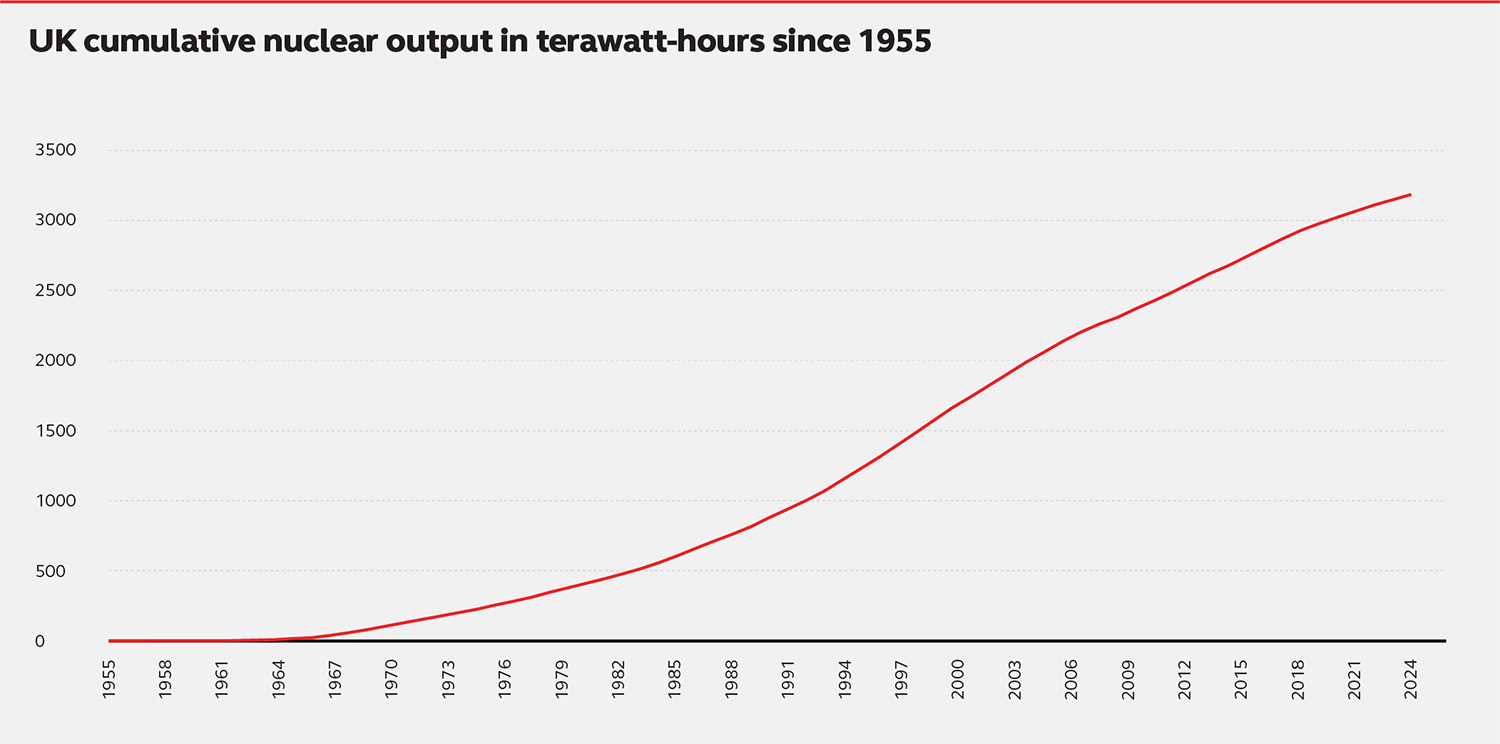
Nuclear electricity operates with virtually no carbon emissions. If coal had generated that electricity instead, more than 3,000 megatonnes of CO₂ would have entered the atmosphere—about 27 years’ worth of exhaust from every car, van, lorry, train, and bus in Britain combined.6 Without clean nuclear power taking the place of dirty coal, 75,000 people would have died early from conditions like asthma and lung cancer.
Across the world, nuclear has produced more than 100,000 TWh since the 1960s—preventing about 2.5 million deaths and 82 gigatonnes of CO₂ compared with coal—roughly the emissions from burning 390,000 tanker‑loads of liquefied natural gas.
For nuclear communities like Whitehaven (Sellafield), Caithness (Dounreay) and East Lothian (Torness), nuclear means thousands of good jobs. Cumbria’s nuclear cluster anchors high-quality jobs: at Sellafield, average pay tops £43,000 and the site underpins about 60% of Copeland’s GVA and jobs.7 Nuclear jobs not only pay well, they are secure too. When nuclear plants close after decades of operation and new ones are blocked or delayed, the impact is painful. On Anglesey/Ynys Môn, median full-time pay at island workplaces fell by 14% between 2016 and 2019 when Wylfa closed and plans for a new nuclear power station on the island fell through.8
Source: DESNZ - Electricity Since 1920
Britain is building again
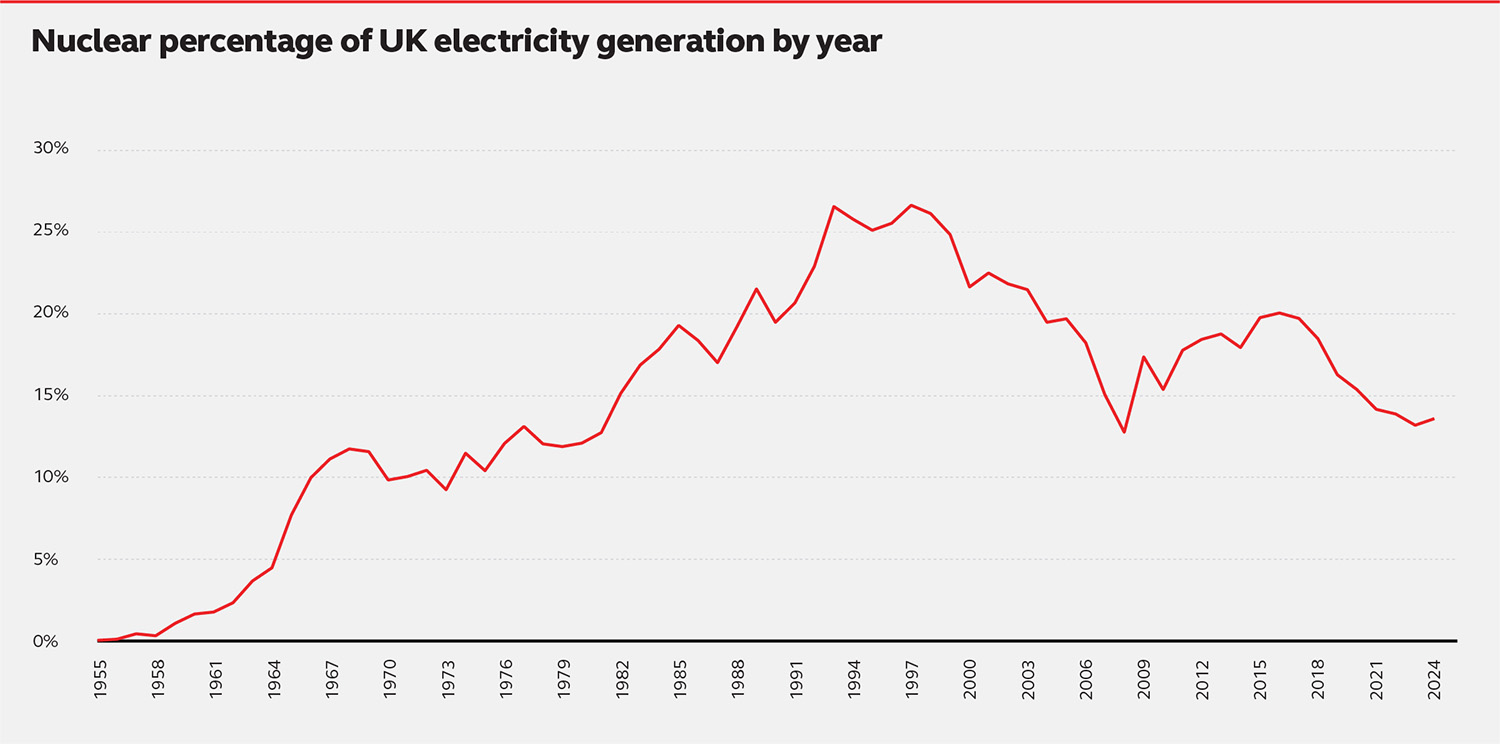
Britain used to generate over a quarter of its power needs through nuclear. Today we produce just 14% this way.9 It has been three decades since Britain last built a new nuclear power station. In that time, more than 6.2 GW of nuclear capacity – plants like Hinkley Point A and B, Dungeness A and B and Calder Hall – entered defuelling and decommissioning. There was a realistic prospect that before this decade’s end, whole months would have passed without a single watt of nuclear power being produced in Britain. For the first time in 66 years, the sun would have temporarily set on British nuclear power. This was avoided by a last-minute stay of execution for Torness and Heysham B – a life extension that Britain Remade campaigned for.10
When Russia’s invasion of Ukraine caused gas prices to spike, British households were left exposed. Energy bills reached eye-watering levels, and would have gone even higher had the Government not borrowed billions to fund the Energy Price Guarantee. Brits looked at the French grid with envy.
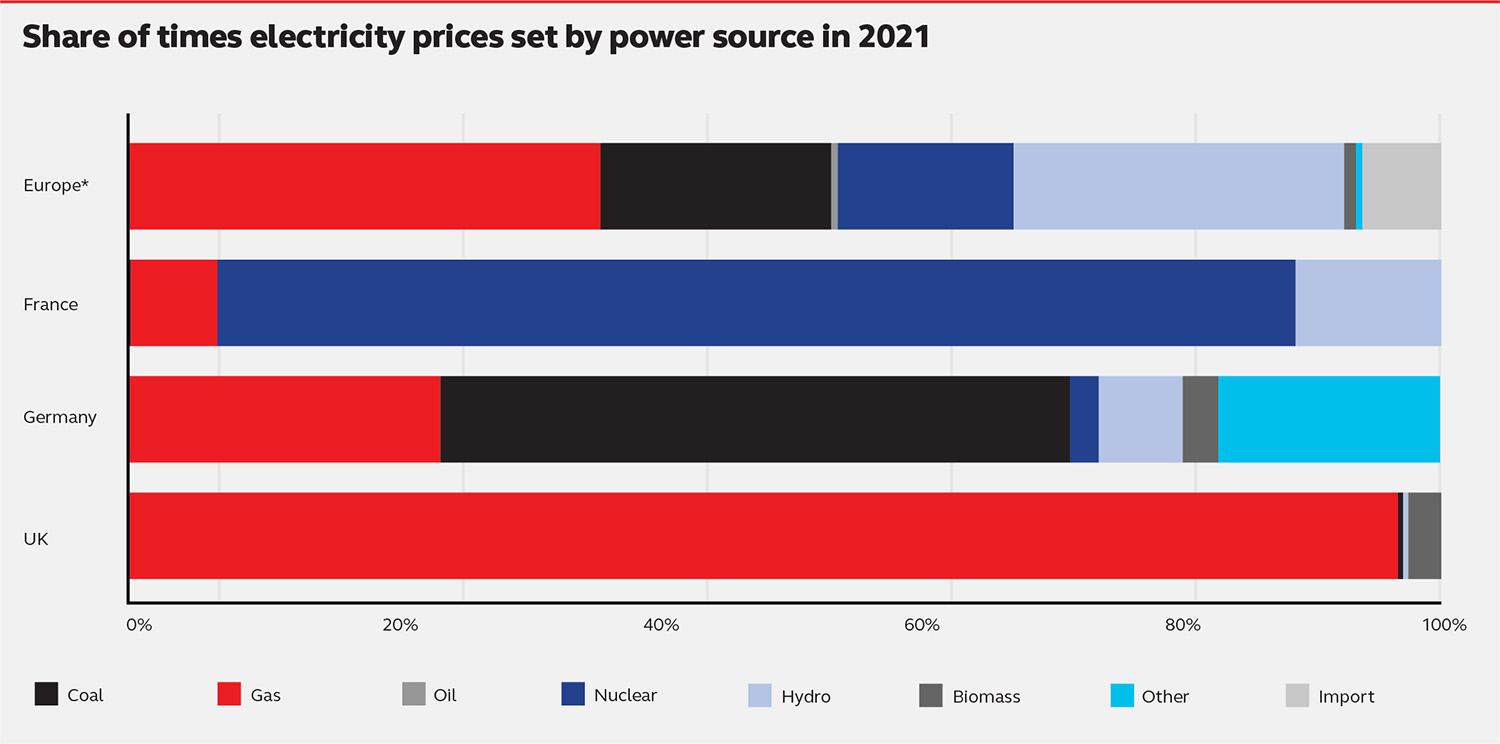
French billpayers pay less because they are less exposed to high gas prices. Gas generates 6% of France’s electricity and sets the price 7% of the time (versus 98% in Britain). In France, nuclear sets the price 80% of the time.11
Britain is now building new nuclear plants again. Hinkley Point C in South-West England has been under construction for nearly seven years –after a decade in planning– and is expected to generate power from 2029. Construction on Sizewell C in the East of England is underway too. When complete, each will produce enough power for six million homes, 13 million electric vehicles, or eight million heat pumps for at least 60 years. The Government is in negotiations with Rolls-Royce SMR to build a fleet of small modular reactors. In South Wales, Last Energy has entered the site-licensing process to build a micro-SMR to power data centres.12 The Secretary of State for Energy Security, Ed Miliband, has declared “a golden age” for nuclear power.13
Yet to meet climate goals, cut bills, and seize the opportunity of AI, Britain will need to bring new nuclear onto the grid at a speed and scale not seen since the 1960s. That will only happen if Britain solves one problem: cost.
Britain is the most expensive place to build a nuclear power station in the world
Britain is an expensive place to build new infrastructure such as trams, road tunnels, and railways. When Britain Remade reviewed over 242 infrastructure projects across 14 countries built in the last three decades, we found that in almost all areas of infrastructure Britain was a high-cost country: either the most expensive country in the world or in the top three alongside the US and Canada.
When we reviewed every single nuclear project built since the year 2000, Britain topped the table for cost per kilowatt capacity. Hinkley Point C is estimated to cost £46 billion, or £14,100 per KW of capacity. When finished, it will be the most expensive nuclear power station built in the history of the world. To put that into perspective, the next most expensive nuclear project – the two new AP-1000 reactors at Vogtle in Atlanta – cost 12% less. Vogtle’s $36.8 billion (£27.4 billion) cost was the result of almost everything that could go wrong going wrong. In the process of construction, its designer and initial project manager Westinghouse filed for bankruptcy, regulators insisted on major design changes extremely late in the project’s development, and there were multiple large construction errors that led to work being redone at great expense.
Vogtle and, to some extent, Hinkley Point C were both ‘first-of-a-kind’ reactors. Building a completely new design from scratch is inherently risky. Expensive mistakes are simply a cost of doing business. In general—“learning by doing” applies far beyond nuclear—costs fall as the second, third, and fourth reactors are built. Sizewell C, which uses the same reactor design as HPC, is still estimated to cost £38bn.14 This is cheaper than Hinkley Point C, but still slightly more expensive than Vogtle when adjusted for inflation.
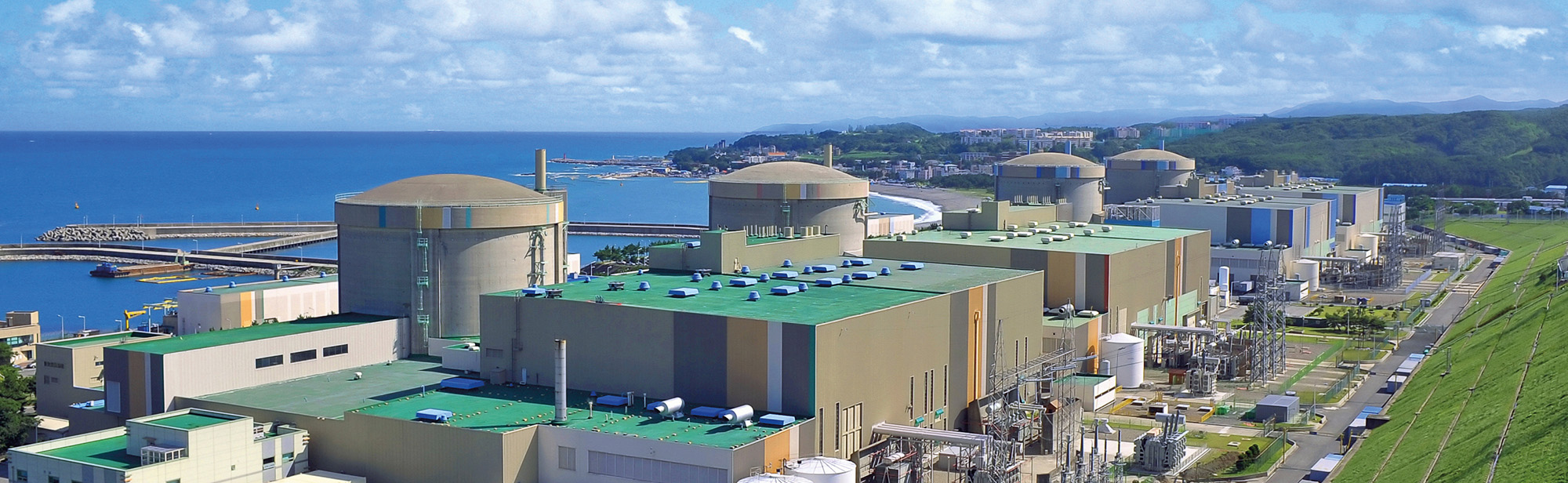
In the 1950s and 1960s, Britain stood out as the world leader in nuclear energy. France took that crown in the 1970s and 1980s when they responded to the oil crisis by opening 57 reactors in 19 years. Today, the country people look to for nuclear energy is South Korea, where since 1983 Korea’s national nuclear energy company KEPCO has built 27 plants in 42 years with three more under construction.
South Korean nuclear plants are built at about one-sixth the cost of Hinkley Point C. If Britain was able to build at South Korean costs, we could have procured enough nuclear capacity to power 36 million homes for the cost of Hinkley Point C.
South Korea’s KEPCO has even built reactors abroad for far less than the cost of Hinkley. The Barakah power station in the UAE—despite no prior nuclear build and major geographic constraints—came in about 70% lower per MW than Hinkley Point C.
Part of the gap reflects Britain’s choice of design. But as well as choosing a more complicated design, we have implemented it more expensively than other countries. France and Finland have built—or are building—European Pressurised Reactors, the same core design as Hinkley Point C. Yet France’s Flamanville 3 cost about 27% less than HPC, while Finland’s Olkiluoto 3 came in at about half the cost.
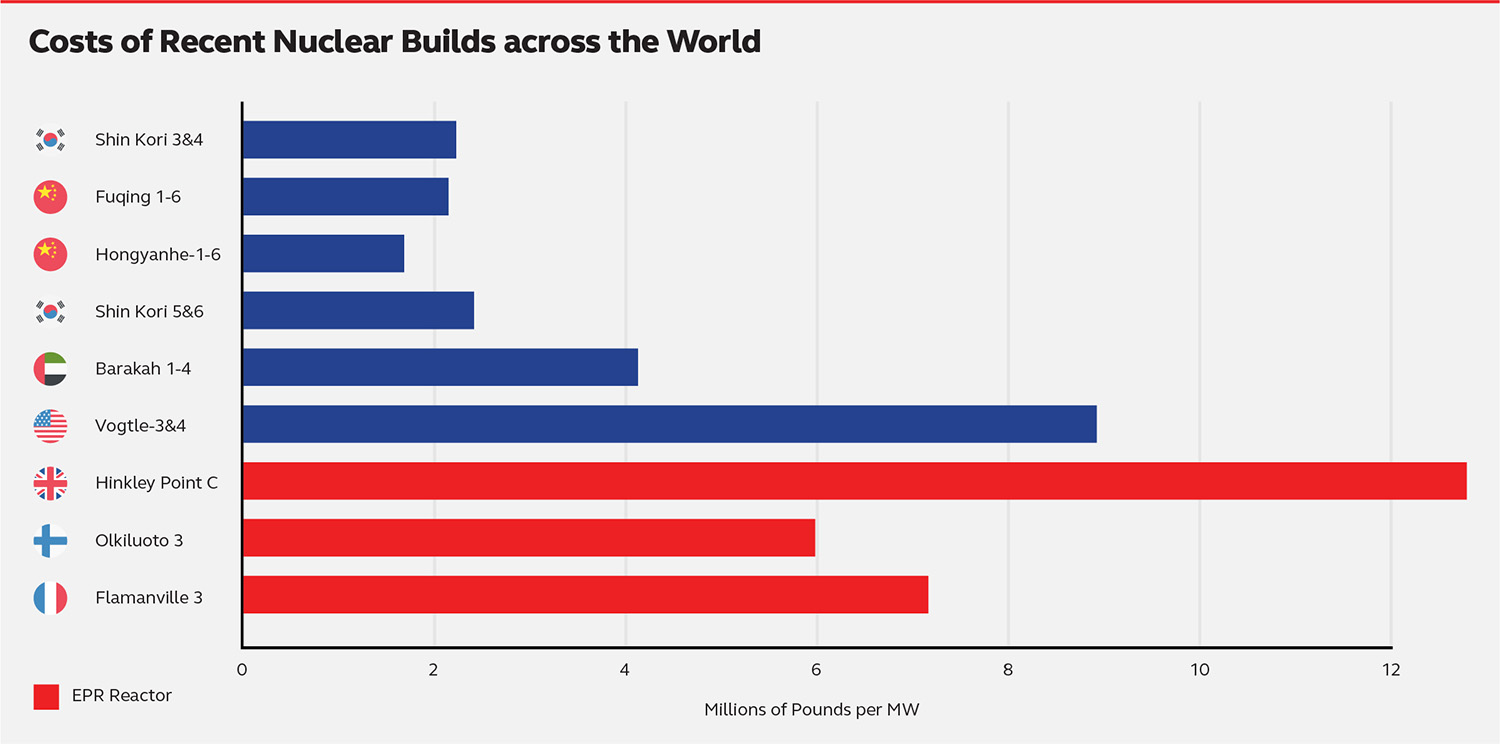
Flamanville 3 was plagued by construction problems. Work had to be redone multiple times because it did not meet standard. Early concrete pours were too wet. Steel reinforcements did not match the blueprints. Welds that should have been neat, continuous seams showed defects and had to be redone, including around pipe penetrations. For safety-critical systems, patching is not an option. Entire sections had to be cut out, redone, and tested extensively. Despite this, Flamanville 3 still cost about a quarter less than Hinkley Point C.
Historically, Britain has often delivered nuclear projects at far lower costs than today, even though they were generally more expensive than those built by our international competitors. The last nuclear reactor completed in the UK, Sizewell B, is the nation’s only pressurised water reactor (PWR), a design deployed 95 times in the US. Built in 1995 at a cost of £6,200 per kW of capacity, Sizewell B still cost less than half of Sizewell C’s projected outturn, assuming the latter is on budget.15
Britain’s first generation of nuclear plants, the Magnox stations built from the late 1950s to the late 1970s, were also substantially cheaper than those currently under construction. Many cost less than half of Sizewell C; even the most expensive Magnox with reliable data—Trawsfynydd—was marginally cheaper.16
The second wave—the advanced gas‑cooled reactors (AGRs)—had a mixed legacy. The Central Electricity Generating Board backed the ambitious British design. They promised refuelling without shutdown, improving load factors. But there was no prototype. The engineering was complex, and each station was unique, which prevented modular construction. These factors drove up costs and led to overruns. Even so, several AGRs (such as Torness, Hinkley Point B, and Heysham 2) are expected to produce electricity at roughly half the lifetime cost per unit of Hinkley Point C. With the exception of Dungeness B, which closed seven years earlier than planned, all AGRs will be cheaper over their lifetimes than Hinkley Point C.17
Britain needs nuclear
Britain needs to end its reliance on expensive dirty gas for three key reasons.
- Burning imported gas is expensive: Britain’s industrial energy costs are the highest in the developed world and almost twice the European average. High costs are shrinking energy‑intensive sectors such as chemicals, plastics, and steel. They also deter investment in power‑hungry data centres and risk the UK falling behind in AI.
- Burning imported gas leaves us exposed to shocks abroad: Russia’s invasion of Ukraine sent gas prices soaring. The average dual-fuel energy bill jumped by 235%. As long as Brits rely on gas to power and heat their homes, British households face large price rises whenever conflict breaks thousands of miles from our shores.
- Burning imported gas causes climate change: Britain has a legally-binding target to reach net zero greenhouse gas emission by 2050. Put simply, Britain cannot meet that target if it continues to burn gas to power and heat our homes. If temperatures rise above 1.5°C, the IPCC forecasts more flash floods, the loss of up to 90% of warm‑water coral reefs, and millions at risk of hunger from crop failures.
Britain cannot end its reliance on imported gas with intermittent renewables alone.
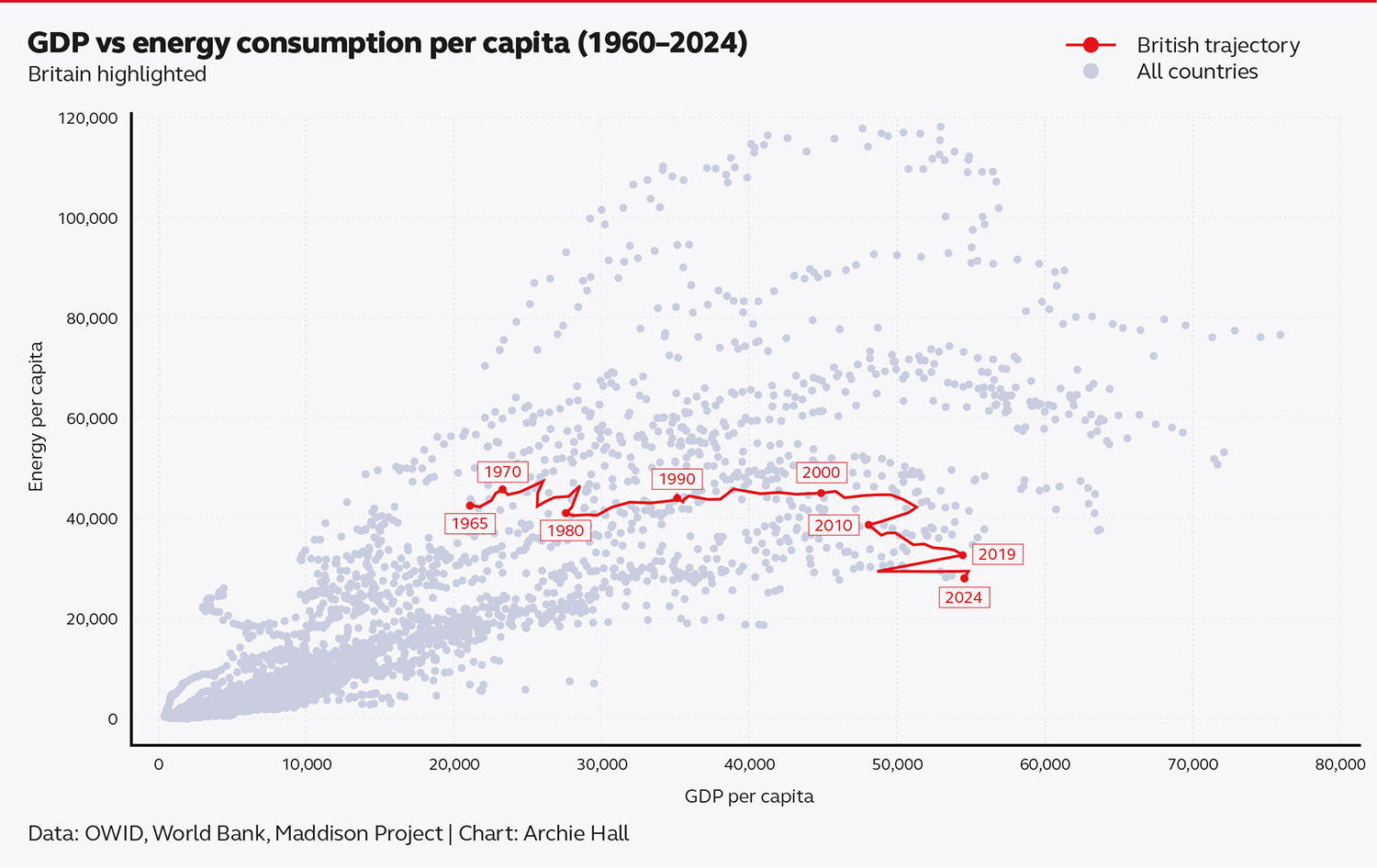
In the last decade and a half, Britain has added an enormous quantity of wind (offshore) and solar to the grid. By adding all of this clean power to the grid, Britain, the country that birthed the industrial revolution, was able to close all of its coal plants. Over that time as the world installed more and more, renewables got much cheaper. The Levelised Cost of Energy (LCOE), which takes into account the costs of building, operating, and maintaining energy infrastructure, has fallen massively for renewables. The cost of building wind farms in Britain has fallen by over a third onshore and over half offshore since 2015.18 Large scale solar costs fell by nearly a third between 2013 and 2021 in Britain and by even more internationally.19 Renewables are playing an extremely important role in Britain’s decarbonisation.
Yet while renewables are part of the answer, they are not the full answer.
The key problem is intermittency. Wind and solar produce power only when the wind is blowing and the sun is shining. Batteries can smooth daily peaks and troughs. The real challenges come in the longer-term, between weeks, months, or seasons. When Britain goes weeks without sufficient sun or wind, keeping the lights on will typically force us to rely on a flexible ‘dispatchable’ form of generation. In practice, that means gas. Britain could and should do more to invest in longer duration energy storage such as pumped hydro, compressed air, and hydrogen, but all of these technologies face major constraints. Some face geographic limits; all face cost constraints.
LCOE is useful for tracking wind and solar’s cost declines, but the metric is limited for a grid where most power comes from renewables, for four reasons.
- You still need the same backup. Britain’s grid is put under the greatest strain during cold, dark winter evenings. If the wind isn’t blowing, then there’s no alternative but to rely on a flexible back-up: gas. As wind and solar take a bigger role on the grid, gas plants run for fewer hours. This saves on fuel, but the cost of keeping a gas plant in working order stays the same. Spreading that big fixed bill over increasingly few hours of generation pushes average costs up.
- The grid needs to balance and that gets more expensive as you introduce more variable generation. More wind and solar makes the job of managing the grid more complicated. A sudden surge in wind can leave the grid’s control room scrambling to get assets to turn off. Curtailment payments—last‑minute pay‑to‑switch‑off orders—are high and rising. The reverse can happen too. When the wind isn’t blowing as much as we expected: heavy energy users are paid to switch off. All of this can get expensive – balancing costs were £2.7 billion last year.20
- You have to overbuild to survive the worst weeks. To almost entirely drive gas off the grid the focus must be on the worst winter lulls, not the average day. In other words, you need to build more than you need for the average day and then store the excess for the lean weeks. The result is paying to build infrastructure that won’t be used to its full capacity most of the time.
- Wind (and to a lesser extent solar) will be constrained without major upgrades to the grid. Britain’s wind resource isn’t evenly distributed around Britain. It is concentrated in Scotland and the East of England. That’s a problem because Britain’s population (and energy demand) is concentrated in the South East. A failure to invest in the grid has left wind farms north of the border unable to send their power down south to where the demand is. Due to our single national electricity market, Scottish wind farms are often paid millions to switch off when the grid is constrained. The National Grid is spending billions upgrading transmission networks to lower these costs.
In other words, even if wind and solar are ‘cheap’ on average, they can still be ‘expensive’ at high penetrations.
Two further reasons make it unlikely that intermittent renewables can meet our needs alone.
AI is power-hungry 24/7. Ever since ChatGPT launched, major tech companies have scrambled to build data centres. In November 2022 NESO estimated that data centres would consume 5TWh of electricity by 2030.21 Two years later, that was revised to 22TWh. In Ireland, just under one quarter of all power generated goes to powering data centres. Ireland has recently announced a de facto moratorium on new data centre projects until 2028 to allow the grid to catch up.22 In other words, banning growth-boosting investments because of a lack of power. Crucially, data centres are ‘always on’. They demand the same level of power around the clock. Unlike other forms of demand that can be flexed (e.g. charging an EV at night, heat pumps powering when electricity is cheap), AI data centres cannot be turned off without making them dramatically more expensive to run. If Britain does not build the clean infrastructure to power data centres, expect them to go to dirtier grids with abundant energy. The US Department of Energy forecasts that American data centres could demand 580TWh by 2028 – nearly twice the UK’s total electricity demand.23
Land. Britain needs to expand its electricity generation massively to meet demand from the electrification of heating and transport. Decarbonising dirty industrial processes by using new technologies, such as making steel with electric-arc furnaces, will mean using more electricity in practice. Adding all of that to unexpectedly large demand from data centres will create genuine land pressures. Although the UK’s 70 GW solar target could use just 0.46% of British land, going further—especially with over‑building—will be challenging. Expect conflicts over land between farming, renewables, and nature recovery. Nuclear, by contrast, is the densest form of power ever invented. To match Hinkley Point C’s annual electricity output, Britain would need a solar farm larger than the Isle of Wight.24
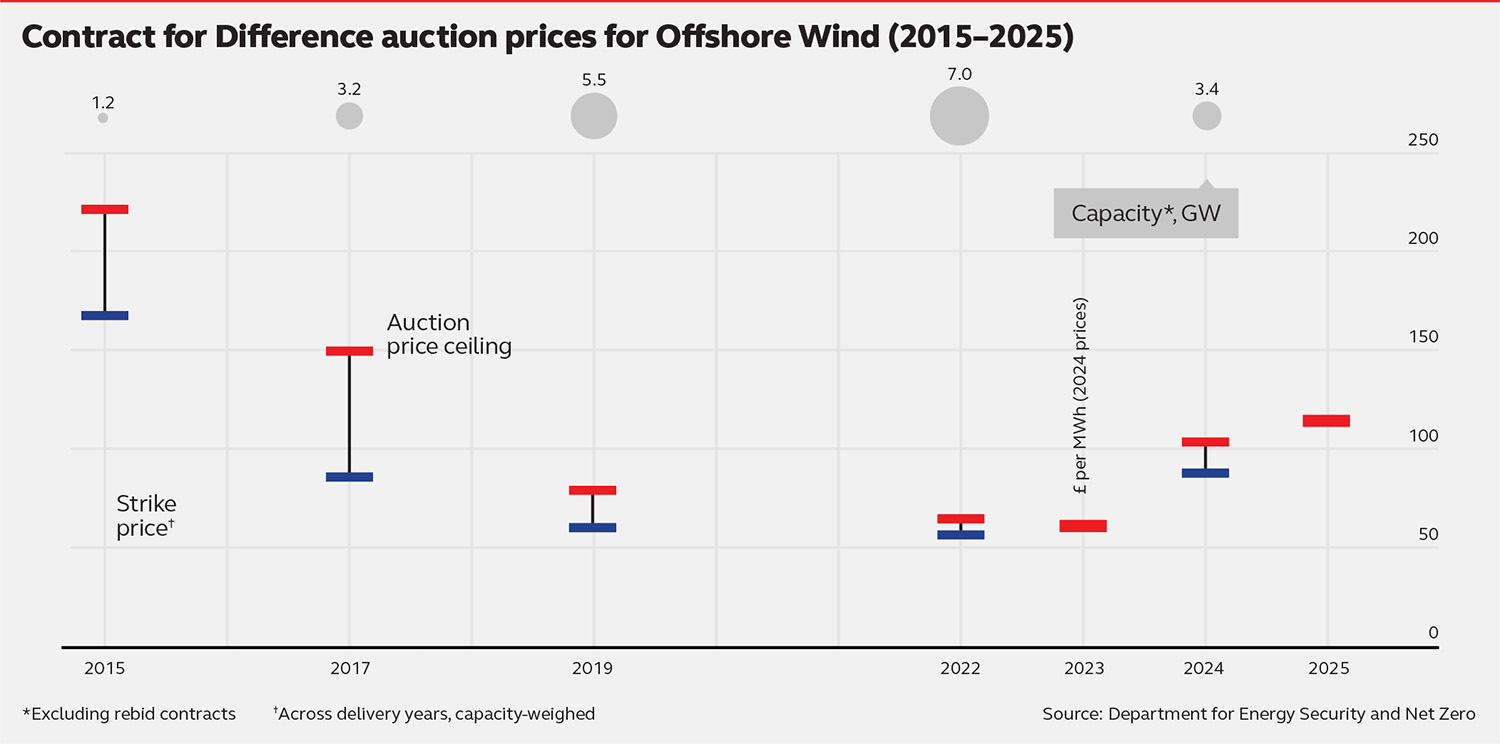
Renewables have seen large cost decreases over the past decade and a half. Solar, in particular, has seen massive declines. The International Energy Agency has consistently under‑estimated global solar uptake. In fact, they’ve undershot it almost every year since the forecast began in 2002.25 Wind costs have fallen too, the Contract for Difference (CfD) auction in 2022 came in at £66.28 for solar and £53.82 for offshore wind (both in 2025 prices).26
The auction that followed in 2023 didn’t clear at all for offshore wind. The Government responded by setting a higher strike price (maximum bid) for the next auction in 2024. It did clear, but the offshore wind price came in well above what it was in 2019 and roughly the same as it did in 2017.27 Offshore wind at these prices costs slightly more than gas currently does. In other words, offshore wind CfDs may help us avoid 2022-style gas price spikes, but they won’t bring bills down from their current unacceptably high levels.
Recent allocation rounds may be a temporary blip. Higher interest rates have raised financing costs for renewable developers. Offshore wind in particular has been hit by a global capacity crunch. Installing offshore wind farms requires specialised vessels. As the world turns to renewables, key inputs are in short supply. Big investments in ports, such as deeper docks and bigger cranes, will have an upfront cost but should lower prices over time. Yet we should be prepared for renewables to cost more than expected. Recent events show it is a mistake to assume costs will always fall.
Why we need to make nuclear cheap again
If renewables costs fail to fall in the years ahead, or worse, rise, then Britain faces major problems. At the moment, the public blame high energy bills on Russia and our reliance on gas, but if Britain cuts gas to just 5% of total power generation and bills remain high, support for climate action is likely to wane. The 2030s will be a critical decade for decarbonisation. If Britain is to meet its legally binding climate targets, it must be a decade of electrification. Families up and down Britain will need to go from heating their homes with gas boilers to heating them with heat pumps. Motorists will need to swap their petrol cars for electric vehicles.
If electric heating costs more than gas, then families won’t do it. If charging an electric car is not much cheaper than petrol, then motorists will not make the switch. More than anything, the pace of decarbonisation in the 2030s will be set by the price of electricity.
If Britain’s industrial electricity prices stay high, then jobs in energy-intensive industries will continue to be lost. At the same time, new AI jobs will go elsewhere as high power costs deter investment.
Nuclear power can bring down Britain’s electricity bills dramatically, but only if building gets cheaper.
Hinkley Point C and Sizewell C are critical low-carbon investments in Britain’s energy system. They do not just cut emissions; they provide firm, always-on power that reduces the need for backup gas plants, oversized renewable fleets, and additional grid infrastructure. Sizewell C’s official Value for Money Assessment estimated that building the plant would save UK consumers £2 billion per year compared to meeting the same need with more wind.
However, modelling commissioned by Britain Remade shows that building another nuclear plant in addition to Hinkley Point C and Sizewell C, at the same price as Hinkley Point C would actually increase bills by £6 per household, assuming energy costs above DESNZ’s baseline scenario.28
DESNZ baselines do assume that solar costs will fall by 27% by 2040 and wind by around 6%. While this is within the range of possibilities, the results for allocation rounds for solar have been similar for many years and wind costs have recently been rising. Therefore we have also modelled if renewables costs rose above the DESNZ baseline by 30%. Even then though, a new plant at Hinkley Point C’s cost would still make bills go up.
If we were able to get costs down to Korean or even French levels building an additional large nuclear plant like Hinkley Point C would cut bills even if Renewables cost perform as well as DESNZ expects. At French cost levels it saves over £4 billion over the 25 years to 2050 for bill payers; at Korean costs, nearly £6billion. At these prices for renewables, building eight more nuclear plants at Korean prices would save £8.9 billion over 25 years.
If renewables costs rise 30% above baseline, building fifteen new plants at Korean prices would be optimal, saving bill payers nearly £21 billion over 25 years. Even at French prices, the most cost‑efficient plan would be to build eight new plants, saving bill payers nearly £7.6 billion over 25 years. PWR plants are built to last at least 60 years, so it is likely these plants would be driving down bills for decades more.

Why Nuclear Is More Expensive To Build In Britain
Britain is an expensive place to build almost anything. From roads to railways, from trams to tubes, British projects are invariably the most expensive. In this sense, nuclear power is not special.
British nuclear infrastructure projects are expensive, in part, because British infrastructure projects are expensive and British infrastructure projects are expensive for more than one reason. After all, to be two, five, or nine times more expensive than peers suggests more than one thing is wrong.
Four causes stand out:
- Slow, resource‑intensive consultation, planning, and permitting processes: For example, offshore wind farms take about two years to build, yet typically more than a decade end‑to‑end when planning is included. Before a single spade is in the ground, developers must run multiple consultations, produce lengthy environmental impact assessments (which can run to 10,000s of pages), and obtain dozens of permits.
- Over-specification driven by political demands and gold-plated regulation: For example, HS2 was built to run at up to 250mph. As a consequence, HS2 was forced to adopt a straighter route requiring more tunnelling and cuttings pushing up costs. In order to comply with the Habitats Regulations, HS2 is currently spending £125m to build a ‘bat tunnel’ designed to protect a small number of bats from the high speed trains.29
- Stop-and-start approach to construction limiting gains from learning and reducing incentive to invest in supply chain (e.g. training and equipment): For example, Britain’s investment in electrifying our railways has followed a ‘feast or famine’ trajectory where decades with almost no electrification are followed by major programmes. As a result, lessons learnt from past projects are often forgotten while supply chains are fragile. In the case of electrification, many workers have left rail to work on the grid. One outcome of a lack of clear pipeline is Britain’s largest construction firms are small by international standards, invest less in skills and equipment, and are heavily reliant on expensive sub-contracting.
- Lack of standardisation and frequent design changes between projects: For example, each British tramway has its own standards, which dictate features like platform height, turning radius, and operational concerns. In effect, each tram project must start from scratch on engineering and design work. Opportunities to cut costs through bulk-buying are limited as a result.
All of the above apply to British nuclear projects.
- The planning process for Sizewell C involved seven consultations, an over 80,000-page environmental impact assessment, and multiple legal challenges.30
- Hinkley Point C had to make thousands of design changes to meet environmental and safety regulations. While every nuclear project faces site‑specific issues, only Hinkley Point C includes a dedicated fish‑return system and an acoustic fish deterrent.31
- Hinkley Point C is the first nuclear plant built in Britain in three decades. Supply chains had to be rebuilt as many people from past projects have retired or moved abroad. In fact, there was only one nuclear qualified welder in the UK when Hinkley Point C’s construction began.
- Hinkley Point C includes several safety features—not present in the French and Finnish units—such as a separate analogue control‑and‑instrumentation system, additional diesel backup, and an extra spent‑fuel‑pool cooling train.
British nuclear construction costs may be the highest in the world, but nuclear costs have increased over time across the world with few exceptions. In general, technologies become cheaper over time as more units are installed. Televisions, computers, and renewables have all seen quality-adjusted price falls over the past 50 years. Nuclear, by contrast, appears to exhibit negative learning. The more we build the worse we get.
Where nuclear projects differ to infrastructure projects more generally is that cost-increasing design changes are often not the result of political demands (e.g. tunneling large parts of HS2 to avoid disrupting the views of people live in the Chilterns) and environmental protection (e.g. building a £125m bat shed for HS2 to avoid disrupting the habits of bats), but the also disproportionate application of safety regulations designed to protect the public from the harm of radiation.
In the United States, nuclear regulation increased sharply in the 1970s. One measure of regulation, the US Nuclear Regulatory Commission’s regulatory guides rose from 21 at the end of 1971 to 143 by the end 1978.32 Not all changes were inadvisable by any means. For example, past rules had assumed the risk of earthquakes and tornados was much lower than they actually were. Yet as a result of the changes the Atomic Industrial Forum estimated that materials, equipment, and labour per watt doubled, while design‑engineering effort tripled. One study estimated that increased regulatory burden raised nuclear plant construction costs by 176%.33
How regulation is making nuclear more expensive
There are two key ways that regulation can make nuclear power more expensive to build.
Direct costs of regulation
People discussing regulation’s impact on cost typically focus on the direct costs. In other words, complying with specific regulatory requirements directly incurs additional expenditure. Direct costs can be straightforwardly identified and measured.
Examples include:
- Environmental Impact Assessments: fees paid to ecologists and lawyers to carry out surveys and produce 80,000‑page assessments.
- Nature Mitigations and Compensation: expenditure on environmental measures such as acoustic fish deterrents (‘fish discos’), fish returns systems, and wetland creation.
- Design Changes: Requirements to re-design stations to add additional safety features, which in turn increases labour, design, and materials costs.
- Judicial Review: Delays incurred due to legal challenges and slow approval processes.
The above costs are meaningful and can, in some cases, be large. For example, the requirement to have a separate analog control and instrumentation system will significantly increase the cost of Hinkley Point C and Sizewell C. At the same time, the total direct costs of the planning process and unique to the UK design changes are unlikely to explain alone why British nuclear plants are 2, 3 or even 6 times more expensive than plants built elsewhere.
Indirect costs of regulation
There’s another major way that regulation can increase construction costs for nuclear (and indeed all forms of infrastructure).
Beyond the direct costs of regulation, regulation can indirectly increase costs by creating barriers to methods and strategies that are proven cost-reducers.
Regulation can undermine proven cost-reducers by:
Limiting gains from learning across projects: There is strong evidence that First-of-a-Kind (FOAK) nuclear projects tend to be substantially more expensive than the third, fourth, or even tenth plant in a fleet. Construction teams become more productive and are less likely to make preventable mistakes as experience with a design grows. Welding at Hinkley Point C’s second reactor building is being done at four times the pace as welding at the first reactor building. This is estimated to generate a 30% saving.34
If frequent design changes and project-specific environmental mitigations impede standardisations, it is likely the cost savings associated with a fleet approach are less likely to be found.
Making it harder to innovate in reactor design and construction: In most markets, innovation is a key driver of cost-reductions. For example, solar panel factories have changed substantially over the last 15 years and have become more productive as a result. In nuclear, changes must be justified with detailed safety cases and can trigger planning delays. Hinkley Point C was required to gain additional planning permission to change its approach for storing nuclear waste based on operational experience.
Deterring investment in supply chains: One key way the fleet approach to nuclear saves money is by creating a strong incentive to invest in the nuclear supply chain. Nuclear construction involves not just specialist skills like nuclear welding but also specialist equipment. For instance, the world’s largest crane, ‘Big Carl’, lifted a 245‑tonne dome onto Hinkley Point C’s first reactor building.
Costs can be saved when expensive investments in workforce training and machinery can be spread across multiple projects. Yet, if uncertain planning processes, legal challenges, and the risk of design changes leads to stop-start construction then these investments will either be more expensive, or not be made at all, such as by using foreign welders instead of training new British welders.
Creating barriers to entry to disruptive competition: Competition forces companies to stay lean and to innovate. In markets where only a few producers can profitably operate (e.g. industries with high-upfront costs such as nuclear), market leaders keep prices low and operate efficiently to guard against innovative competitors who have the potential to undercut them offering an entirely new product.
Expensive licensing and planning processes can create a significant additional hurdle for new innovative competitors who bear large costs before a single order is made.
Increasing the risk associated with financing fleets: Building fleets, as Britain did in the 1960s, France did in the 1980s, and South Korea does now, means that large upfront costs can be spread over multiple projects and leading to substantial ‘learning-by-doing’ between projects. However, the fleet model, in order to work properly, requires that nearly every decision, especially planning and financing, are ‘one and done’ at the beginning. No developer or operator can make a fleet model investable if they are subject to enormous risks that there will be planning delays or required design changes.
Preventing the use of modular construction through increased design complexity: Additional environmental mitigations and safety features such as a hard-wired analog backup increase the complexity of plant designs. As a result, projects are less able to use modular construction (e.g. built in a factory assembled on site) and more reliant on civil works with greater construction risk.
Our plan to cut costs
In February, the government announced a taskforce led by John Fingleton, former head of the Office of Fair Trading, to “examine all aspects of the regulation of civil and defence nuclear”.35 Major regulatory reform is a pre-condition of reducing the cost of building new nuclear in Britain to Finnish, French or even South Korean levels. The Taskforce’s Interim Report is robust, criticising a “culture of risk aversion irrespective of cost, increasingly complex processes and procedures, and excessive bureaucracy.”36
The stakes are high. If the taskforce is radical and its proposals are adopted, the prize is enormous: Lower bills, lower emissions, protection from volatile fossil fuel markets, and if we are really successful, an industrial renaissance in the UK. Reducing the cost of new nuclear powerstations in Britain is crucial, not just because a clean energy mix with nuclear will be cheaper, but also because the defining technology of the 21st century – AI – needs reliable power. If Britain is unable to create the conditions for rapid cheap nuclear deployment, then it sets up a sharp choice between decarbonisation and economic growth.
Britain Remade has a plan to cut the cost of building new nuclear. Developed after extensive engagement with industry and reviewed by leading experts from the Universities of Cambridge and Liverpool, our plan targets three key areas where Britain’s existing approach to regulating and financing nuclear projects increases costs, discourages innovation, and provides, at best, minimal public benefit.
- Britain’s approach to regulating the risks of radiation exposure (and why it is disproportionate)
- Britain’s planning system for major infrastructure (and why it is not fit for purpose)
- Britain’s electricity market arrangements (and how they block private investment into new nuclear)
Regulating Radiation
Nuclear is a safe technology
No way to generate electricity is risk‑free, but risks differ. A handful of people die each year installing solar panels on rooftops. Tracking the dangers in mines for the critical minerals used in windfarms at ‘artisanal’ mines in the developing world is difficult but reports of deaths are frequent.37 Even in developed countries mining is a risky business.38 When the Banqiao Dam, a hydroelectric power station in China burst in 1975 over 25,000 people died in the subsequent flooding.39
When you adjust for deaths per unit of energy produced it becomes clear that some technologies are much safer than others. Burning fossil fuels, by a distance, is the deadliest way to generate power. Coal is more than 1,000 times deadlier than solar. Deaths from natural gas are rarer but still about 100 times more common than from wind or solar.40
Nuclear is an exceptionally safe technology. Our World in Data’s review of scientific studies finds nuclear is roughly as safe as wind or solar power, or put differently, between 100 and 1,000 times safer than burning fossil fuels.
Radiation is all around us. It occurs naturally in rocks and soil, in cosmic rays from the Sun and outer space, and in trace amounts of the food we eat. It is not unique to nuclear power. More than half of the total radiation exposure to the global public from electricity generation is due to coal. Renewables, which depend on rare earth metals like neodymium, expose workers to radiation in mining. For example, the UN Scientific Committee on the Effects of Atomic Radiation (UNSCEAR) found that workers mining rare earth metals for solar were exposed to radiation levels forty times higher than those faced by nuclear workers.41
This is not to say that radiation poses zero risk to the public. There is a well-established scientific link between high levels of radiation exposure and ill health, in particular, cancer. The ‘gold standard’ of radiation health research is the Hiroshima/Nagasaki Life Span Study, which followed Japanese atomic bomb survivors at key lifetime milestones (age 30 and age 70).
People over 1.1km from the centre of the blast were exposed to around 1,000mSv in one go and were 47% more likely to develop a solid-cancer. The risks persisted over decades and could be detected - at a linearly lower rate - at exposures as low as 100mSv.
Put differently, if 100 people were exposed to 100mSv in one go, then on average one additional person would develop cancer as a result.42 To put that into perspective, 42 of the 100 would develop cancer for other reasons. For context, 100mSv is ten times the dose received from a whole spine CT scan and more than 50 times the average Briton’s annual background dose.43
When radiation levels fall well below 100mSv, epidemiology is a limited guide. The core problem researchers face is determining whether any increase in cancer rates is driven by radiation exposure or statistical noise. In one paper Prof Gerry Thomas, who led the Chernobyl Tissue Bank at Imperial College London, pointed out that “a population of one billion individuals would be needed to detect a statistically significant risk of cancer at a dose of 1mSv.”44 (Because the increase we would predict from such a dose is so low.) This study would also need to follow each individual over the full length of their life. In short, it would be the most expensive scientific study ever created.
In response to the clear difficulties in assessing radiation harms at lower doses, the field of radiation protection has adopted a approach known as the Linear No-Threshold (LNT) hypothesis. Put simply, it assumes that if exposing 100 people to 100mSv causes one additional case of cancer then so does exposing 1000 people to 10mSv and 10,000 people to 1mSv (and so on and so forth).
UNSCEAR, the Health Physics Society, and the International Commission on Radiological Protection both state clearly that due to high uncertainty at low doses – it is inappropriate to add up 100,000s of tiny doses (e.g. sub 1mSv) and use them to estimate cancer rates.45 46 47 It would be like assuming that if 4,000 men cut themselves shaving and each lost 1ml of blood then one would die of blood loss.
The radiation doses members of the public are exposed to due to nuclear power are extremely low. Britain runs annual Radioactivity in Food and the Environment (RiFE) surveys each year. The purpose is to estimate the highest annual exposure to radiation someone nearby might receive. Using dosimeter readings and local-food samples, they calculate the dose received by someone living close to the plant, eating over a kilo and a half of fish, crustaceans, and mussels per week, and regularly visiting nearby beaches. At Hinkley Point, this individual would receive an annual additional dose of 0.032mSv each year.48 This is equivalent to eating 320 grams of Brazil Nuts, or spending a weekend in Cornwall.
Given the extremely low radiation exposures near nuclear power stations, it is unsurprising that a recent study, commissioned by UK’s Independent Committee on the Medical Aspects of Radiation in the Environment (COMARE), which covered every single registered cancer case within 25km of every UK nuclear site found no increase in leukaemia, brain tumours or any other cancers, and no other pattern of higher risk in nearby populations.49
People worry not only about normal operation but about accidents such as Three Mile Island, Chernobyl, and Fukushima. The worst — Chernobyl — stemmed from a fatally flawed RBMK design, never used in the West, and a reckless, rulebreaking safety test. Chernobyl also had no containment vessel.
Chernobyl has been studied extensively. In the immediate aftermath, 134 first responders received very high doses; 28 died within months. The most significant impact of Chernobyl was the increase in thyroid cancer rates for people who were exposed to contaminated food and milk as children. About 1% of early‑onset thyroid cancers lead to death within 50 years. Upper‑bound exposure estimates suggest up to 16,000 additional cases—around 160 premature deaths.50
The radiological impact on the wider Ukrainian and Belarussian populations was limited. Around six million people were exposed to an additional 10mSv—the equivalent of one CT scan—spread over 20 years. No one was hurt outside the USSR. UNSCEAR estimates that around 200 people had their lives shortened in total by Chernobyl and none of the other civil nuclear disasters we have experienced can be shown to have led to any early deaths.51
It is important to put the risks of radiation exposure into perspective. The 100-200mSv exposure received by workers involved in the Chernobyl clean-up is estimated to have increased their annual risk of death by 1%. Yet, a worker moving from rural Inverness to London will see their annual risk of death jump by 2.8% as a result of air pollution. The extensive safety features at Hinkley Point C and Sizewell C mean that in the extremely rare event of a core meltdown at Hinkley Point a local will be exposed to just a few mSv worth of radiation – around a third of the dose someone might receive from merely living in Cornwall.52
How Britain regulates radiation risks
Britain regulates the radiological risks from nuclear power under Health and Safety laws. At the heart of Britain’s Health and Safety legislation is a sensible idea: In our day-to-day lives, risk is unavoidable. Eliminating it would not only be impossible, it would be undesirable too. Almost every worthwhile activity from driving to work to taking a vaccine carries some risk. Yet not every risk is worth the reward.
Health and Safety laws divide risks into three broad categories. At one end, there are unacceptable risks where the risk (or severity) of harm is high and the benefits cannot justify exposing people to that avoidable risk. For example, drink-driving might be faster than getting the night bus but it is not worth the risk of causing a fatal accident. At the other end, there are risks that are broadly acceptable, where the risk of harm is low and clearly outweighed by the benefits. For example, crossing the road at a zebra crossing.
There’s a third category in the middle: tolerable, if As Low As Reasonably Practicable (ALARP). These are risks that can be tolerated, if measures have been taken to reduce that risk as low as reasonably practicable. For example, riding a bike to work. Wearing a helmet (along with lights and a maintained bike) is a reasonably practicable control, whereas fitting adult stabilisers or requiring an escort vehicle would be grossly disproportionate to the risk. In other words, reduce risk until the costs of further measures clearly outweigh the benefits, while erring on the side of caution.
In Britain, health‑and‑safety responsibilities fall on dutyholders; for nuclear, that is the site licence holder. Our approach is goal-based, not prescriptive. Dutyholders (i.e. the nuclear plant licensee) are free, in theory, to meet outcomes in whatever way they deem the most suitable. The advantages of goal-based regulation are clear: they allow for innovation, do not lock dutyholders into inappropriate solutions, and they are evidence based. Yet, there are drawbacks too. In some cases, it is unclear what must be reduced to ALARP. In some cases, this can lead dutyholders to add safety measures far beyond what legislation requires.
Whether an activity is unacceptable, tolerable if ALARP, or broadly acceptable is determined by two numbers. The Basic Safety Limit (BSL), which determines the upper limit of what can be considered tolerable. For normal operation, this is 1mSv for off-site exposures. This is far below the region where a link between exposure and cancer is well–established and well within the regional variation in natural background radiation in the UK.53 At the other end, there is the Basic Safety Objective. Reducing radiation doses below the Basic Safety Objective (0.02mSv or the equivalent of flying for five hours) is considered a poor use of the regulator’s time. At this level, risk can be considered broadly acceptable and dutyholders are, in theory, not required to prove they have reduced risk to ALARP beyond this.
ALARP, or more precisely its international cousin ALARA (as low as reasonably achievable) is applied more pragmatically in other countries. In the US, it is an explicit cost benefit analysis using a flat dollar per rem (equivalent dose to 10mSv) figure of $7,200 provided certain dose targets are met.54
ALARP should not, as Health and Safety Executive guidance states: require us to constantly raise standards, require everyone adopt the standards of the employer with the highest standard of risk control, or require us to reduce risk to zero.
How disproportionate safety regulation increases costs
Britain’s approach to regulating the risks from radiation is sound in theory: reduce risks (but not to zero) and, only when it is proportionate, erring on the side of caution. The problem is not with the underlying approach, but with the outcomes it delivers.
ALARP and gross disproportion
The application of ALARP to nuclear power frequently leads to the adoption of expensive safety measures to reduce risks that are already extremely low, in other words grossly disproportionate. To some extent, it is unfair to blame the Office for Nuclear Regulation when grossly disproportionate safety features are adopted – their incentive and legal duty is to only consider safety – the responsibility to challenge recommendations on gross disproportionately rests with the dutyholder. At times, expensive changes are pro-actively brought forward by dutyholders based on a sometimes inaccurate view of what the ONR would actually accept. This is not an issue with the regulator’s behaviour itself, but the incentives created by the regulatory system.
When the ONR commissioned the economic consultancy NERA to assess its economic impact, one of the key findings was that challenge from industry is extremely rare and that there was only one case where cost–benefit analysis was used to oppose an ONR request: a filtered vent to release steam and gas through a particle‑trapping filter in the event of a meltdown. The ONR eventually accepted EDF’s argument that the vent would only reduce radiation exposure by a tiny amount in events that are extremely unlikely and already covered by other safety features.
Industry may be failing in its duty to provide challenge, but the root cause is the structural incentives set by regulation. These include:
- The cost of commissioning safety cases and cost-benefit analyses: To challenge an ONR suggestion will involve preparing extensive analysis of risks and costs. This is expensive – nuclear engineering and radiation safety experts do not come cheap – and there’s still a risk the ONR will not be persuaded by the analysis. There’s an additional cost too: time. Preparing a strong safety case or gross disproportion challenge can take months delaying projects. As a result, some may decide that it simply is not worth the hassle to challenge a decision.
- Indeterminate timescales for challenges to be resolved: Investors want certainty, yet the timescale for resolving a challenge on the grounds of gross disproportion is not clear-cut. Some decisions are made quickly, but it could easily lead to lengthy back-and-forths. When there’s a risk this could drag on for months (or even years) that has major implications for financing.
- The risk that challenge undermines the dutyholders’s good standing: The ONR regulates organisations not designs. Dutyholders will be wary that if they are too oppositional and challenge every recommendation on cost grounds then the ONR would view them as lacking a ‘safety culture’. This could also have impacts on planning – if the public learns that the regulator is regularly in opposition to the site operator they will be more likely to oppose the development.
- Lack of clarity over the definition of gross disproportion: The legal test for gross disproportion is that the sacrifice is clearly out of proportion to the reduction in risk. However, there’s a lack of guidance and clarity over when something is and when something isn’t grossly disproportionate. One issue is that the ratio of costs to benefits needed to prove gross disproportion isn’t fixed. The Sizewell B Inquiry, for example, used a range of ratios – three for worker risk, two for the lowest public risks and ten for the largest high-consequence nuclear risks. The idea of using different ratios for different risks is itself philosophically suspect – after all, the severity of the risk should be captured on the cost-side of the equation.
- The difficulty in comparing quantitative and qualitative claims: Part of the problem is that regulators often are asked to balance qualitative and quantitative information. For example, a dutyholder may warn that implementing certain safety measures would make the reactor £100m more expensive to build. On the other hand, the safety measure may be expected to save a single life. In many areas of public policy, we assign a monetary value of life to allow us to work out these decisions. For example, the National Institute for Clinical Excellence assumes spending up to £30,000 is worth it to save one Quality Adjusted Life Year. The Treasury’s Green Book uses a figure of £2.467m per fatality to guide decisions on whether to make additional investments in speed cameras, flood defences, and low-emission buses. We may be squeamish about assigning a value to a human life, but money protecting people from small radiation risks is money that cannot be spent on road safety. Additionally, only direct costs to the dutyholder are considered - the wider benefits of nuclear power such as decarbonisation are not factored in.
Relevant Good Practice
In order to be considered ALARP, dutyholders must be using Relevant Good Practice (RGP), which can range from following regulatory guidance and industry standards to using practices that have a record of safe operation. The issue is that there is no clear hierarchy or weighting to guide what is and isn’t RGP. When different sources of RGP conflict, it can be difficult for dutyholders to work out what is and is not needed to comply.
In some cases, features that may have been RGP at one time are no longer necessary due to new reactors having additional safety features. Britain last built a new reactor 30 years ago, so relying on domestic precedent is likely to lead to design changes that are inappropriate to reactor types only built overseas.
One key issue is that designs in operation abroad have to be redesigned to be considered RGP in the UK. For example, EDF has raised concerns that in order to comply with British environmental and nuclear safety regulations they were forced to make thousands of design changes to the EPR. Not only did this limit the gains from repeating a standardised design that was safe enough to satisfy French and Finnish regulators, it also led to significantly more steel and concrete being used.
One major change was the requirement to install a separate failsafe hardwired control system. This involved doubling the number of control and instrumentation cabinets and adding hundreds of kilometres of cabling. Another was the requirement to add two additional floors of HVAC in the four safeguard buildings. Neither was required by the French regulator for Flamanville 3.
Many of the components inside the reactor building are provided by the same manufacturers, but require extensive additional safety testing and certification to be used in the UK. All of this raises design complexity and limits the gains from specialisation.
There are four Advanced Boiling Water Reactors (ABWR) in Japan. It is a design with an excellent safety record – notably surviving the Tōhoku earthquake which caused the Fukushima accident. GE Hitachi Nuclear Energy planned to build two in Wales on a site near Wylfa power station in Anglesey/Ynys Môn.
Although the ABWR has an outstanding safety record, GE Hitachi were required to make significant design changes in order to comply with RGP to pass the Generic Design Assessment. The most notable was the installation of bulky HEPA filters on each heating, ventilation and air‑conditioning (HVAC) duct.55 Beyond the filters themselves, this would have added costs to the layout of the building’s ventilation system and increased the amount of waste that needs to be disposed of. The safety benefits were tiny to non-existent. The filters would cut public exposure by 0.0001mSv (about one banana‑equivalent dose) in normal operation. In an emergency they would be redundant because there are already separate containment and filtration systems with HEPA filters.
The ONR insisted on the HEPA filters because they are considered RGP in the UK. The issue is that the UK, unlike the US or Japan, built gas-cooled Magnox and AGR reactors that continuously create particulate-laden gas effluents and lack a sealed containment. The core issue is that the ABWR is a completely different design to Britain’s Magnox and AGR fleet. Installing HEPA filters for this purpose on an ABWR is like installing a catalytic converter on a Tesla.56
Case Study: Westinghouse AP-1000’s Generic Design Assessment
When Westinghouse proposed bringing its AP-1000 reactor to Britain, one of the key things the ONR challenged during the Generic Design Assessment process was the layout of the spent-fuel pool: the water-filled pond where used fuel assemblies sit for several years while they cool and their radioactivity dies down.
In the original US design, the pool is densely packed. Westinghouse splits the racks into two zones: “fresh-out” assemblies go into positions with extra neutron-absorbing material, and older, lower-power assemblies are moved into tighter-packed positions. Making that work safely depends on well-written software and operators rigorously following loading rules so the fuel always stays comfortably sub-critical (i.e. there is no chance of a self-sustaining chain reaction starting in the pond). This approach has been used extensively in the US with a strong safety record.
The ONR however assessed that Relevant Good Practice was only to use ‘administrative controls’ when there was no practical engineered solution. In this case, there were engineered alternatives available. A total of eight different options for the fuel pool were considered at length. One option was to have a larger fuel pool. This was rejected by Westinghouse because a large fuel pool turn would have necessitated a larger nuclear island. In other words, it would have meant radically redesigning the plant layout, losing the benefits of standardisation. The alternative that was eventually accepted was to give every fuel rack the same fixed spacing. This allowed the fuel pool to stay the same size, but meant around one-third less spent fuel could be stored and which would increase operational costs.
Historically, nuclear plants relied on active systems to prevent major accidents, with backup diesel generators often in the highest safety category (Class 1 in the UK, “safety-related” in the US) because they were essential for cooling the reactor and containment.
In the AP-1000, passive systems such as gravity-fed water, natural circulation, and passive heat removal, can cool the core and containment for extended periods without power. The US regulator therefore classifies its diesel generators as non-safety.
In the UK, however, they are Class 2 because they support post-accident recovery, including battery charging, monitoring and ventilation, residual heat and component cooling, spent-fuel pool cooling, and refilling the passive containment cooling tank. The UK’s multi-tier classification system, compared to the US’s two-tier approach, brings stricter quality-assurancerequirements. These can raise costs and limit suppliers, creating supply-chain challenges. No one believes the US approach is unsafe, only that the UK demands additional, often expensive, assurance.
This was not the only case where something was classified as safety-related in the UK but not the US. For example, the AP-1000 has a remote shutdown room in case of an accident. In the US, the remote shutdown room uses digital controls and the equipment was not classed as safety-related due to the plant’s passive features. The UK’s unnecessary extra rules have meant that an additional very expensive class 1 safety panel was required despite the fact it was extremely unlikely it would ever need to be used.57
What needs to change
Change the mindset of Britain’s nuclear regulator
Deploying safe, clean nuclear power is essential to the Government’s Clean Power and Economic Growth missions, yet the Office for Nuclear Regulation has no duty to promote nuclear energy and limited scrutiny from elected officials.
Part of the problem is that the ONR is sponsored by the Department for Work and Pensions, a department where nuclear regulation will never be a top ten priority, and as a result, lacks ministerial scrutiny. This is a legacy of the Nuclear Installations Inspectorate sitting under the Health and Safety Executive.
One potential rationale to maintain the DWP’s sponsorship is to maintain the regulator’s independence from influence by commercial interests. However, this approach is unusual within the UK. For example, the Civil Aviation Authority is responsible for airline safety, but is sponsored by the Department for Transport. Natural England and the Environment Agency are sponsored by Defra.
The ONR’s sponsorship would be suited to a number of different Departments. For example, the Department of Business and Trade hosts the Regulation Directorate, while the Department for Energy Security and Net Zero (DESNZ) has a clear interest in the energy security and climate benefits. In South Korea, where nuclear is deployed cheaply the nuclear regulator (and environmental regulator) report directly to the PM allowing for fast approval processes. As multiple departments have a clear interest in nuclear regulation, a similar approach may be justified. The ONR’s sponsorship should be moved from the Department for Work and Pensions to the DESNZ.58 To enable effective scrutiny, the Cabinet Office should chair a regular committee attended by DESNZ and the Department for Environment, Food and Rural Affairs to co-ordinate work and address cross-cutting issues such as duplicative requirements. This should be modelled on the ‘Star Chamber’ idea put forward in the Ministry of Housing Communities and Local Government Policy Paper Getting Great Britain Building Again.59
There is currently no duty for the ONR to consider energy security, economic growth, or net zero. In theory, it is possible for the ONR to have successfully discharged its mandate in a world where no new nuclear power stations are ever built.60 The US, by contrast, recently passed the bipartisan ADVANCE Act, which updated the Nuclear Regulatory Commission’s mandate to “enabling the safe and secure use and deployment of civilian nuclear energy… through efficient and reliable licensing… for the benefit of society and the environment.” The ONR should be given a new objective to promote the safe and secure deployment of civil nuclear power for the benefit of society, the economy, and decarbonisation.
Challenges to ONR decisions are relatively rare. One reason is that dutyholders may feel deterred from challenging the ONR’s decision-making because it is expensive, time-consuming, and may lead the ONR to look unfavourably at future applications. The Government should require the ONR to create a ‘regulatory red team’ with a mandate to enable and deliver new nuclear energy to scrutinise its decisions and report up to ministerial level. It should have the authority to act as an appeals mechanism for dutyholders and require the ONR to publish cost-benefit analyses.
Restore proportionality to nuclear regulation
The most expensive and unnecessary design changes in the UK have been driven by ONR’s interpretation of Relevant Good Practice (RGP). The lack of a clear hierarchy of RGP creates uncertainty over what is and is not required leading developers to err on the side of caution. Many of the most disproportionate requirements such as the HEPA filters required for the ABWRs privilege UK operational experience over safe operational experience worldwide. In the case of the ABWR and AP-1000, the ONR required changes based on UK operational experience and did not treat US and Japanese safe operational experience as RGP despite the UK experience being based on very different reactor designs (i.e. gas-cooled reactors). With the exception of nuclear design codes and Approved Codes of Practice that have a footing in statute, the strongest weighting should be assigned to safe real-world operation. The ONR should be required to publish a clear hierarchy of RGP and place ‘real‑world safe operation in an International Nuclear Regulators’ Association (INRA) country’ at the top. There should be recognition that RGP should be based on demonstrated safety improvement applicable to that reactor type. The ONR should also review all of the published RGP documents looking at their relevance and the extent to which they overlap or conflict with other sources of RGP in INRA countries, with a special focus on markets with high significance to SMR vendors, such as the US.
Many of the reactor designs Britain wants to build are already licensed and running safely in countries with respected regulators. ONR does not currently treat those overseas approvals and safety analyses as “good practice by default”, so vendors must re-run work that has already been done and accepted elsewhere. This duplication creates long, variable reviews and pushes effort away from Britain-specific issues such as site hazards. The Government should require ONR to accept safety analyses from peer regulators by default and limit extra work to cases where UK-specific factors clearly justify it. This would mirror the unilateral recognition approach adopted post-Brexit for medicines regulation, where drugs approved by top overseas regulators are automatically approved here.
In theory, dutyholders can challenge design changes on the grounds of gross disproportion, but challenges are rare and cost-benefit analyses are almost never used. Part of the issue is that many benefits, such as fatalities prevented or life years saved, are not assigned a value as they would be in other areas such as railway or road safety. A clearer definition of Gross Disproportion and an accepted figure for the value of preventing a fatality would make it much clearer what can and cannot be challenged. The ONR should be required to support dutyholders to challenge ALARP decisions by creating a clear definition of Gross Disproportion (Exceeds a Cost-Benefit Ratio of 2) and using the Treasury Green Book Value of Prevented Fatality figure.
The Basic Safety Objective sets the level below which risks or dose go from being ‘tolerable if ALARP’ to ‘broadly acceptable’. However, it is often treated by regulators and dutyholders as a target rather than a floor to prevent unnecessary gold-plating. The duty to reduce risks or dose to ALARP should be automatically considered discharged when exposures are below the Basic Safety Objective (BSO) level. Such that below this value the regulator has no ability to require the further reduction in risk or dose. In addition:
- For Fault Conditions: The Basic Safety Objectives used for nuclear faults are set far below risks accepted in everyday life. For example, the BSO for off-site persons (i.e. someone living nearby) is equivalent to the risk of driving 200 miles on British roads. The BSO should be raised to be in proportion to other risks we consider broadly acceptable. The ONR should commission a review of the BSOs for faults and assess whether they are in line with other high-hazard industries and the international nuclear community. The review should also set a clear cut-off for individual accident sequences so ultra-rare events that fall outside the plant’s standard design assumptions—but are still checked as rare “what-ifs”—do not end up driving costly changes. For extremely rare external hazards, for example, an earthquake so severe it might occur only once in a million years, limited data has previously encouraged undue pessimism, and the review should examine how regulators handle such cases without excessive costs. For very low frequency events the costs are real: the EPR uses multiple separate emergency core-cooling trains—well beyond the norm in most reactors. This over-design appears to have been recognised as excessive with the ERP2.
- For Normal Operations (Occupational Exposures): between the Basic Safety Objective and the Basic Safety Limit (20mSv per year for workers) where the operator/developer has demonstrated ALARP, and there is a challenge to introduce further design changes by the regulator, the burden of proof on gross disproportion for any design request should be on the regulator to prove and should be time-limited.
- For Normal Operations (Public Exposures): In the case of the exposure to the public under normal operations, regulation of routine discharges of radioactivity to air or water is regulated by the environmental regulator (Environment Agency in England, Natural Resources Wales in Wales and the Scottish Environment Protection Agency in Scotland) through the permitting or authorisation of radioactive substances. Meanwhile routine external radiation dose to the public from the development is regulated by the ONR. The ONR and EA apply a BSO of 0.02mSv which applies to the summation of doses from both discharges and external dose. The value of this BSO is equivalent to a quarter of the radiation someone taking a transatlantic flight would be exposed to, and 100 times less than the average exposure a member of the public receives in the UK from natural sources.661The BSO for normal operation should be raised to a value between 0.15 and 0.3mSv per year mSv. These are the values set by the UK Health Security Agency as an Upper and Lower Dose Constraint, a threshold for optimisation, to ensure an appropriate level of protection. This would place the BSO at roughly 10% of the UK’s annual background dose, and less than what the average member of the UK Public gets from naturally occurring radiation in the food we eat.
In addition to the BSO the environmental regulator refers to a “threshold of no regulatory concern” set at 0.01mSv per year.62 This value defined by the International Atomic Energy Agency is considered sufficiently low that doses arising from sources or practices that meet these criteria may be exempted from regulatory control. Despite the current new nuclear plants in the UK giving doses less than this threshold, the same level of regulatory controls are applied both below and above this threshold. For facilities demonstrating doses below the threshold of no regulatory concerns the developer/operators should be granted a “Light” Radioactive Substances Permit/Authorisation, with requirements reduced simply to monitoring discharges and confirming they are discharging within these limits.
Modernise and streamline regulation for new nuclear technologies
Regulatory Justification requires vendors to show that, for a given reactor design, the benefits outweigh the costs of any public exposure to ionising radiation. This is something they do on multiple occasions through the site licensing, development consent, and GDA process. This creates a significant upfront for startups promoting new designs such as SMRs. The Defra Secretary should make an immediate ruling that all new reactor designs are considered justified provided they acquire a site licence or planning approval.
Requirements (under the Paris and Brussels conventions) to obtain third-party liability insurance of £1.2bn are one-size-fits-all and do not account for the lower-risk profile of SMR/AMRs nor the realities of modular factory manufacture, new fuels such as HALEU/TRISO, and nuclear transport. The Government should create a new SMR/AMR “low-consequence” category under the Nuclear Installations (Prescribed Sites and Transport) Regulations 2018 with a substantially lower liability requirement and review third-party liability arrangements for new nuclear technologies.
Modern designs (and SMR/AMRs) can, and in many cases do, have significantly lower risk profiles, but regulators still require extensive emergency plans based on older designs. Outline Planning Zones (OPZ) Detailed Emergency Planning Zones (DEPZ) should be based on evidence, not historic practice. The Radiation (Emergency Preparedness and Public Information) Regulations 2019 (REPPIR) should be amended so the current 30KM OPZ for reactors is replaced by a design-specific, evidence-based approach. In cases where doses at the site perimeter are below the level that triggers urgent action, the DEPZ should be eliminated.
The Semi-Urban Population Density Constraint greatly restricts the sites available for new nuclear projects. The requirements, based on the risks of old gas-cooled power plants, not modern designs, restrict opportunities for industrial co-location. The EN-7 National Policy Statement and ONR Siting guidance should replace the Semi-Urban Population Density Constraint with a risk-informed approach based on site-specific hazard and consequence assessments.63
To encourage innovation and avoid unnecessarily burdening innovative startups with large fixed costs, the ONR should be required to assess technical design first, then the plant, site, and organisational capability in the Nuclear Site Licence process. This is a more modern approach that shifts focus from excessive documentation to radiological and industrial safety outcomes. This ‘gated’ licensing system mirrors Canada’s system and would allow SMR developers to proceed through the licensing process without the substantial upfront cost of having all organisation capabilities in place.
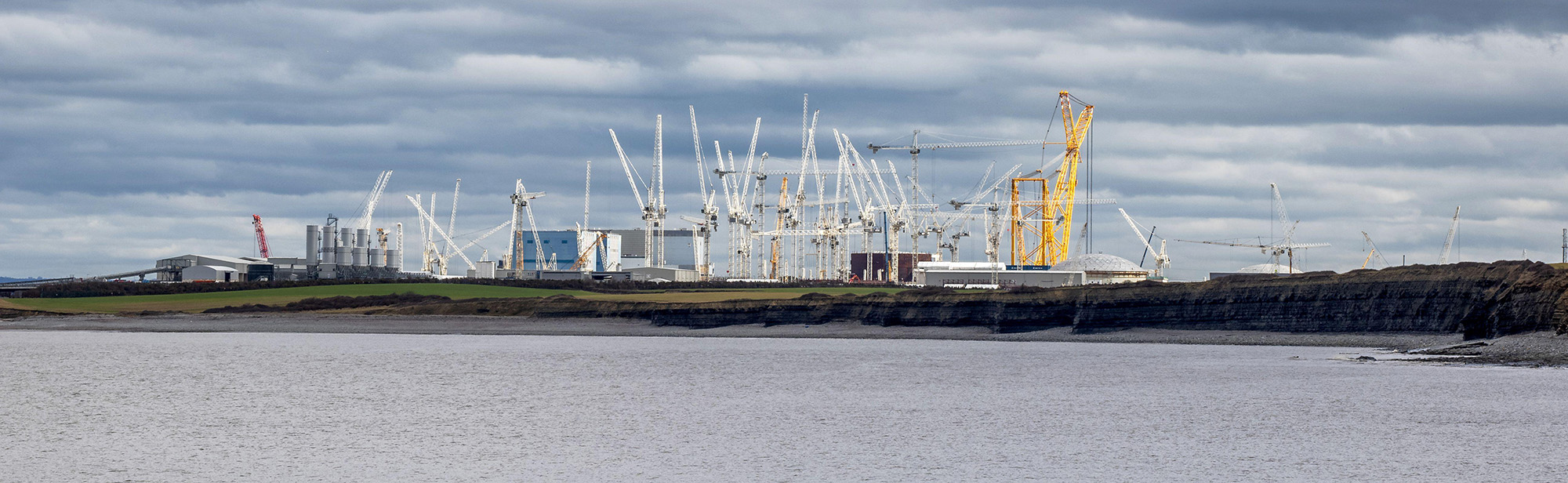
Planning and Environmental Permitting
Nuclear is green
When it comes to the environment, nuclear has a perception problem.
In June 2025, YouGov found that 34% of Britons regard nuclear power stations as not environmentally friendly (45% say they are). In 2021, only about half of the public identified nuclear as a low- or zero-carbon source—versus roughly four in five who said the same for wind and solar.
In the early days of nuclear power, before the risks of climate change were widely understood, environmentalists often welcomed it as an alternative to smog-producing coal or ecologically disruptive hydropower. By the 1970s, however, attitudes shifted. Concerns about nuclear waste and weapons were central, but the change was also bound up with the broader cultural currents of the time: distrust of institutions, disillusion with science as a source of progress, and a new strand of environmentalism that saw technology itself as a threat. The mistake was to view nuclear power in isolation rather than weigh it against the harms of the alternatives.64
A single tiny uranium pellet can power a British home for 2 years. It would take 400 cubic metres of natural gas to do the same. To generate the same amount of power with offshore wind for 2 years requires around 200 grams of rare earth minerals, which contain natural radioactivity. For every gram of neodymium used in a wind turbine generates a gram of radioactive waste. A single 5MW onshore wind turbine will generate 250kg’s worth of radioactive waste.65
Used nuclear fuel must be handled with care, yet fears over the dangers of nuclear waste are overblown. When spent fuel is removed from a nuclear reactor, it is transferred into large steel-reinforced concrete containers. Waste can be stored here for around 100 years and the containers are safe enough to walk up and touch. To generate one person’s lifetime household electricity use wouldn’t produce enough waste to fill a shot glass. All of the nuclear waste ever produced in Britain plus all the waste from another 100 years of generation could be stored in a building the size of Wembley, or about 0.00002% of the UK’s land mass.
Nuclear’s density extends to land use. To produce the same amount of power as Hinkley Point C in a year would mean building a solar farm the size of the Isle of Wight or an onshore wind farm the size of the entire New Forest. Britain has the land to do either and some forms of farming can co-exist with renewable generation, but every extra acre of land dedicated is an acre that cannot be used for nature recovery. If capacity factors fall due to the need to over-build then even more land will be needed.
Far from harming wildlife, many UK nuclear sites act as quiet nature reserves because access is restricted and the land is left largely untouched; at Dungeness, for example, black redstarts and peregrine falcons nest on the station, while over 20,000 wintering waterbirds use the surrounding shingle and wetlands.
All forms of power generation impact nature. Yet, the biggest threat to biodiversity is man-made climate change.
Crucially, nuclear is one of the lowest carbon forms of generation. Like wind and solar, nuclear produces zero emissions in generation. When you factor in emissions across the full life cycle from mining and construction to operation and decommissioning, nuclear on average emits less carbon than wind and solar. The crucial point is not whether nuclear is a gram of CO₂ per kilowatt‑hour lower than wind or solar, but that nuclear, wind, and solar emit about one‑twentieth as much as gas and about one‑sixtieth as much as coal.
Nuclear faces extreme planning barriers
Rules and regulations designed to protect nature and the environment are having the unintended consequence of frustrating the deployment of the cleanest source of power there is.
Environmental Impact and Habitats Regulation Assessments: In order to obtain planning permission to build Hinkley Point C – close to two existing (both now decommissioned) nuclear power stations – EDF were forced to produce a 31,401 page Environmental Impact Assessment. When they applied 8 years later for permission to build Sizewell C – also close to two existing nuclear power stations – they produced 80,000 pages of environmental documentation to support their application. In total, across the two nuclear power stations EDF produced more pages of environmental documentation for the planning inspectorate than two full sets of 32 volume Encyclopaedia Britannica.
Contained within those mammoth assessments are surveys covering invertebrates, amphibians, reptiles, bats, birds, mammals, and plants. Surveys can only take place at certain times. For birds that means at least one breeding season and one winter. For some marine life such as ichthyoplankton (fish larvae/eggs) three years worth of survey data is needed. EDF will have employed hundreds of ecologists and spent millions of pounds. Yet the largest cost is delay, nuclear power plants can take as long as a decade to build, but pre-application surveys extend that process even further. If a new nuclear project was proposed tomorrow, it is unlikely a planning application would be ready to be submitted before the end of parliament.
Post-Consent Permitting: To build and operate Sizewell C over 160 separate permits are required. Many of which have substantial overlap and are, at least, partially duplicative. These include:
- Marine Licenses from the Marine Management Organisation;
- Water Transfer, Impoundment, and Abstraction licenses from the Environment Agency
- Protected Species Licenses from Natural England
- Land Drainage Consents from the Internal Drainage Board
- Control of Major Accident Hazards (COMAH) Notification from the Health and Safety Executive.
Even when a developer has been awarded planning permission to build a nuclear power station, which as we have noted involves extensive environmental assessments, they can still be required to carry out additional Habitats assessments in order to secure secondary consents. In some cases, Habitats Assessments from the DCO can be extracted and reused. However, this still requires developers to adapt the Habitats Assessment to the specific activity and there is a risk that different regulatory bodies demand different standards of evidence. For instance, some might argue that surveys performed for the DCO are now out of date given the length of the planning process. In principle, if environmental conditions have declined since the DCO was granted, the relevant statutory nature conservation body (SNCB), such as Natural England, could advise the decision‑maker to refuse the permit to discharge a planning condition. In other words, a nuclear project could be halted after construction has begun. In a recent blog post, the lawyer Catherine Howard, who worked on Hinkley Point C and Sizewell C’s DCOs notes that she is aware of some cases where offshore wind farms are being forced to produce Habitats Assessments to acquire minor marine licenses to carry out cable repairs.66
To install Hinkley Point C’s cooling water intakes, EDF needed to dredge large amounts of mud. In 2013, they gained a licence to dispose of that mud at a designated mud dumping site near Cardiff. Dredging was delayed however because of extensive push-back from Welsh politicians based on misinformation about the level of radioactivity of the mud – in reality, dumping the mud would only have exposed nearby members of the public to the radioactive equivalent of eating two bananas.67 As the process dragged on, a space opened up at a nearby dumping site in Portishead. Anti-nuclear campaigners responded by launching a legal challenge on the grounds that EDF needed to carry out an additional Habitats Assessment to dump the mud. This legal challenge failed, but it did manage to delay vital dredging work for a year. The risk of future legal challenges on similar grounds will have a chilling effect. Developers uncertain as to whether or not they need to carry out additional assessments for post-consents licenses are likely to do them out of fear of being delayed by legal action.
Environmental Mitigation and Compensation: Britain is one of the most nature-depleted countries in the world. Britons care about nature and want to protect it, yet Britain’s system of protections for threatened species and habitats delivers the worst of both worlds.
In order to comply with environmental legislation, nuclear projects are forced to invest in expensive and, critically, inefficient mitigations. One example is the acoustic fish deterrent proposed for Hinkley Point C. To prevent fish entering Hinkley Point C’s cooling water intake (and dying), EDF plans to install speakers near the intake playing jumbo-jet level noise designed to deter fish from entering. Not only would this so-called “fish disco” be expensive and sit on top of the world’s first “fish returns system”, initial plans would have put commercial divers at risk of death to perform regular maintenance. In the 12 years since the idea was first suggested a new technological solution was discovered that would be cheaper to install and maintain.68
This system works for neither developers nor nature. Designing site-specific interventions is time-consuming and expensive for developers. In the case of nuclear, mitigations can be particularly problematic if they force developers to meaningfully change a design executed successfully elsewhere.
Site-specific interventions are rarely the most effective way of protecting nature. Paying farmers to create wetlands will almost certainly save more fish per pound than installing an acoustic fish‑deterrent.
For Wylfa Newydd on Anglesey/Ynys Môn, the Planning Inspectorate recommended that the Secretary of State refuse consent in part because the development might affect the population of Arctic terns. Part of the issue was the difficulty in proving that the birds would return later. This was a significant, though not the sole, factor in the project falling apart.69
Part of the challenge for nuclear power is that because land near existing nuclear plants have deliberately been left untouched by human activity for decades, most proposed nuclear plants at designated sites are surrounded by protected sites rich in biodiversity. Nuclear is a victim of its own greenness.
Consultation (and Statutory Consultation): When the Labour politician Tony Benn, then-Britain’s Energy minister, visited France in the 70s to learn about their nuclear programme. He asked a French official how they gained public consent for such a major programme of building. The official’s response: “You don’t ask the frogs when you’re draining the swamp.”
France’s approach in the 1970s was extreme, yet Britain’s approach today is also extreme. Between 2014 and 2022, there were no fewer than seven public consultations for Sizewell C.70 In theory, consultation allows developers to address potential issues at an early stage and build public support. In many cases, consultations lead to high levels of local support for nuclear projects. For example, 63% of residents within 25 miles of Hinkley Point C and 61% of residents in East Suffolk (the local authority that includes Sizewell) support the project.71
Consultation, however, is not working. Consultation is a statutory requirement for major infrastructure projects – this requirement is to be removed if the Planning and Infrastructure Bill passes – and as a result, failing to adequately consult can be grounds to refuse planning permission or challenge a project’s legality. As a result, developers are engaging in extensive and over-thorough consultation in order to avoid future legal challenges. Consultation has shifted from a meaningful and useful process to a box-ticking exercise.
It is not just the public that has to be consulted either. Before a planning application can be even submitted developers must consult a wide range of bodies as known statutory consultees. These range from the Environment Agency and Natural England to Sports England and Historic England. In theory, these bodies should offer specialised advice and help identify issues before they arise later in the process when changing plans is harder. However, there have become a growing source of delays within the planning process. Statutory consultees are meant to respond within three weeks; these deadlines are often missed with Natural England the worst offender.
Judicial Review: Between Hinkley Point C and Sizewell C, there have been seven separate legal challenges against nuclear projects in the last twelve years. Six of the seven are planning related - the exception being a challenge to Hinkley Point C from Austria and Germany on the grounds it amounted to illegal state aid. In total, they delayed work on Hinkley Point C by 866 days. Since August 2022, Sizewell C has spent 827 days fighting ultimately unsuccessful legal challenges. One challenge covering additional coastal flood defences is still ongoing.
| Project | Case | Delay | Summary |
|---|---|---|---|
| Hinkley Point C | An Taisce v SoS (DCOJR) | 625 days; 30 Apr 2013 - 15 Jan 2015. Unsuccessful. | Claimed transboundary EIA consultation with Ireland was required; lost in HC/CA; Supreme Court refused permission toappeal. |
| Hinkley Point C | Greenpeace (DCO JR) | 150 days; 29 May 2013 - 26 Oct 2013. Withdrawn. | JR against the DCO; claim withdrawn. |
| Hinkley Point C | Tarian Hafren v MMO (marine licence variation JR) | 91 days; 23 Dec 2021 - 24 Mar 2022. Unsuccessful. | Challenged MMO’s power to vary licence to allow disposal at Portishead; dismissed. |
| Sizewell C | TASC v SoS (DCO JR) | 617 days; 30 Aug 2022 - 8 May 2024. Unsuccessful. | Multiple grounds incl. potable water/habitats; refused at rolled-up HC; CA dismissed; Supreme Court refused PTA. |
| Sizewell C | TEAGS/Stop Sizewell Cv ONR (site licence JR) | 210 days; 7 May 2024 → 3 Dec 2024. Unsuccessful. | Tried to quash ONR’s nuclear site licence over sea-defences point; dismissed as “totally without merit”. |
| Sizewell C | TASC v SoS (seek DCO review/variation for coastal flood defences) | 61 days so far; 5 Jun 2025 - ongoing | JR over additional coastal flood-defence works said to be omitted from the DCO; pending. |
Project
Hinkley Point C
Case
An Taisce v SoS (DCOJR)
Delay
625 days; 30 Apr 2013 - 15 Jan 2015. Unsuccessful.
Summary
Claimed transboundary EIA consultation with Ireland was required; lost in HC/CA; Supreme Court refused permission to appeal.
Project
Hinkley Point C
Case
Greenpeace (DCO JR)
Delay
150 days; 29 May 2013 - 26 Oct 2013. Withdrawn.
Summary
JR against the DCO; claim withdrawn.
Project
Hinkley Point C
Case
Tarian Hafren v MMO (marine licence variation JR)
Delay
91 days; 23 Dec 2021 - 24 Mar 2022. Unsuccessful.
Summary
Challenged MMO’s power to vary licence to allow disposal at Portishead; dismissed.
Project
Sizewell C
Case
TASC v SoS (DCO JR)
Delay
617 days; 30 Aug 2022 - 8 May 2024. Unsuccessful.
Summary
Multiple grounds incl. potable water/habitats; refused at rolled-up HC; CA dismissed; Supreme Court refused PTA.
Project
Sizewell C
Case
TEAGS/Stop Sizewell Cv ONR (site licence JR)
Delay
210 days; 7 May 2024 → 3 Dec 2024. Unsuccessful.
Summary
Tried to quash ONR’s nuclear site licence over sea-defences point; dismissed as “totally without merit”.
Project
Sizewell C
Case
TEAGS/Stop Sizewell Cv ONR (site licence JR)
Delay
210 days; 7 May 2024 → 3 Dec 2024. Unsuccessful.
Summary
Tried to quash ONR’s nuclear site licence over sea-defences point; dismissed as “totally without merit”.
Project
Sizewell C
Case
TASC v SoS (seek DCO review/variation for coastal flood defences)
Delay
61 days so far; 5 Jun 2025 - ongoing
Summary
JR over additional coastal flood-defence works said to be omitted from the DCO; pending.
Legal challenges, even unsuccessful, have two major impacts.
First, the knowledge that every word in a 80,000 page (or even longer) planning application will be tested in court embeds caution into every decision. Unnecessary surveys are commissioned. The strictest interpretation of every aspect of planning guidance and environmental guidance is taken as written. Projects move slower as a result and expensive environmental mitigations are proposed.
Second, legal challenges, even when unsuccessful, can create substantial delays to projects. This can push up costs significantly. In their submission to the Banner Review into Inappropriate Legal Changes, National Highways estimated that delays caused by unsuccessful legal challenges have increased the cost of building a new major road by £60m to £120m.72 National Highways projects are large in many cases costing over a billion pounds. However, their projects are small compared to a Hinkley or Sizewell-scale project where costs run into the tens of billions. If legal challenges to nuclear projects have comparable impacts then the total cost of delay could run into the billions. When financing costs are high, as is the case with nuclear projects, a year’s delay can have massive financial implications.
How planning makes nuclear more expensive
Britain’s slow, uncertain, and inflexible planning system is a key driver of our high nuclear costs.
Ineffective, but legally required, mitigations such as acoustic fish deterrents and fish returns systems not only add complexity to construction, they also increase the number of changes between projects within a fleet. This extends the FOAK problem and reduces the opportunity for learning-by-doing.
Not all design changes increase costs. In many cases, operational experience can lead to certain practices being identified as more efficient. For example, Hinkley Point C was originally intended to use a ‘wet’ store for spent fuel. However, international experience revealed that ‘dry’ stores - while larger - are easier to operate. Switching to a dry store not only required EDF to obtain a new consent from the Environment Agency, but had to apply to the Planning Inspectorate to update their planning consent because switching systems will mean the building the waste is actually stored in will need to be about 79m longer. The cost of applying for additional planning permission in both time and money deters developers from making changes to their design at a late stage unless they are extremely confident it will generate a sufficient saving.
Uncertainty in planning, both over the time it takes to win approval and the probability a project will be refused permission, threatens the viability of the fleet approach. Investors are unlikely to order an entire fleet – and bear the large upfront costs of a first-of-a-kind reactor project – if they are uncertain projects two, three, or five will be approved.
Long and expensive planning processes are a barrier to the deployment of Small Modular Reactors in particular. Hinkley Point C and Sizewell C can spread the cost of the planning process over two massive units. For small projects, those fixed costs are still there, but they can’t spread them over the same amount of generation. In other words, our planning system biases investment towards building a few large mega-projects and away from building many smaller projects.
The delays and risks involved create a barrier to entry for new innovative SMR builders. Every survey, consultation, and legal challenge extends the construction timeframe further. SMR startups will have to bear large upfront costs for years before their reactor generates its first watt of power.
What needs to change
Protecting nature effectively
Extensive environmental impact and Habitats Regulations assessments significantly extend the development timeline for new nuclear power stations. In many cases, they lead to expensive and ineffective mitigations adding risk to the development process. It is right to want to protect and enhance nature, but existing policies do not work for nuclear nor nature.
One major issue is that even De Minimis impacts can count as an adverse impact on the integrity of a protected site. As a result, even extremely small impacts such as losing half a percent of a habit within a site or even a single bat death can lead to a stage three Habitats Regulation assessment requiring compensation or alternative action. The Habitats Regulations should be amended to clarify that ‘de minimis’ impacts do not have an adverse impact on a site’s integrity, including in combination with de minimis impacts from other projects.
Britain’s laws and regulations are not, as a rule, drafted by scientists. In the case of the Habitats Regulations, they are worded such that they require ecologists to ‘prove a negative’. This, in turn, leads to an extreme degree of caution. In other words, developers must act as if a protected species is present even if surveys are inconclusive. This leads to more studies than necessary and, on occasion, mitigations for impacts that are unlikely to occur. To fix this, the Habitats Regulations should be amended to remove the requirement to prove a negative and require scientific evidence of an impact before Natural England can block a plan.
When there are likely adverse impacts, developers are required to find mitigations and if they can not, provide compensation. One problem is that conservation regulators like Natural England require like-for-like compensation. As Catherine Howard, a lawyer who worked on Hinkley Point C put it: “if your power station risks killing a certain type and number of fish, you must show how that type and number of fish will be replaced at or near that site by your compensation proposals.”73 The problem is like-for-like compensation can be difficult to design and is unlikely to be the most effective use of money for nature. Like-for-like compensation is not required by the EU Directive from which the Habitats Regulations are derived, but nonetheless conservation bodies like Natural England treat it as a requirement. The Habitats Regulations should be amended to clarify that compensation measures can include measures that benefit the national network of protected sites, provided they either benefit features affected by the plan/project or contribute towards meeting an Environment Act 2023 strategy in the vicinity of the project.
Most of Hinkley Point C and Sizewell C’s environmental assessments were carried out post-consent to acquire additional construction permits, licenses and consents. In the case of Hinkley, this created an additional opportunity to bring a legal challenge which delayed a crucial part of construction for over a year. If the Habitats Regulations Assessment (HRA) at the DCO stage is meant to be “bounding” (covering the full project) then small works within that approved envelope should not need to be reassessed post-consent. The Habitats Regulations should be amended so that the requirement to produce a Habitats Regulations assessment does not apply to licenses, permits, and conditions for projects that have been granted planning permission.
Many sites for new nuclear power stations are surrounded by ‘National Landscapes’ (the new term for AONBs). A new measure in LURA requires projects that impact on National Landscapes to further their purposes. This vague legal requirement has led to large and variable requests for payment.74 The Government should legislate to amend the Levelling Up and Regeneration Act to remove the vague duty to further the objectives of National Landscapes.
Eliminate unnecessary bureaucracy
In order to build a nuclear power station, developers can be required to obtain over 160 permits, licenses and consents. Many of the permits cover essentially the same activity, while others overlap and could be combined. For example, the requirement to acquire an Impoundment licence granted by the Environment Agency and a Land Drainage Consent from the Internal Drainage Board means that two separate licenses are required for the same activity. The large list of permits, licenses, and consents required after planning permission is granted should be reviewed and where activities are duplicative, rationalised.
Developers are required to consult Statutory Consultees in advance of submitting their planning application. Statutory Consultees are legally required to respond within 21 days. However, a significant proportion of Statutory Consultees are failing to respond in a timely manner. In some cases, this is leading to significant delays. In order to get statutory consultees to respond within legal timeframes, the government should legislate to create a rule of positive silence: a failure of a Statutory Consultee to respond to a request within 21 days should count as them having waived their right to object.
Reduce the incentives to fight new development
Lawsuits are being used to delay and disrupt nuclear projects creating substantial risk for developers and making it harder to invest in nuclear. There is a clear domestic mandate for nuclear power, which shouldn't be frustrated in the courts. Under the Aarhus Treaty, legal challenges against nuclear on environmental grounds benefit from a costs cap which effectively subsidises opponents of green energy if they lose their case. This is an exception to the UK’s long-standing ‘loser pays’ principle where the person losing a legal case is required to pay the costs of the winner. These cost caps, set at £5,000 and £10,000, should be raised substantially and should not apply in cases where legal challengers have the means to pay costs, or have demonstrated substantial ability to fund cases using crowdfunding, or have repeatedly lost similar cases. The Planning and Infrastructure Bill’s proposed reduction in the number of opportunities litigants have to renew cases are welcome and will reduce delays, but should also apply to lawsuits challenging permitting and site licenses.
Locals should be incentivised to support new nuclear, but at the moment are discouraged by the fact that 50% of business rates from new projects go to the Treasury, not local people. The Business Rates retention system should be reformed to allow councils to fully retain business rates for new SMR, Large-Scale Nuclear, and Data Centre projects.
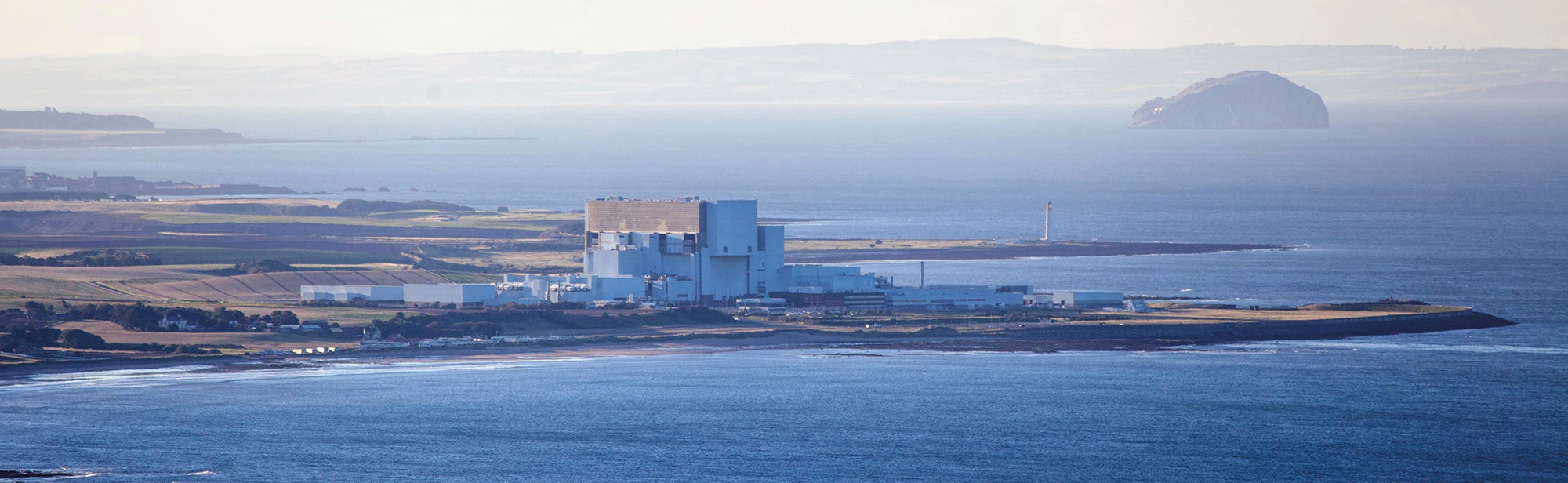
Unlocking Private Investment For SMRs
The Small Modular Opportunity
Since 1956, Britain’s nuclear plants have been large-scale projects requiring extensive civil works. To get Hinkley’s workforce in each day, EDF were forced to build the second largest bus station in Europe. Hinkley Point C will use 1.8 million cubic metres of ‘nuclear grade; concrete and 22,000 tonnes of steel. In return for all of this, Britain will get a nuclear plant capable of generating enough energy to power 6 million homes.
Yet large projects – megaprojects – are expensive and often can only be financed with large guarantees from the state. Given the large risk involved, it is understandable that there has never been a private sector large-scale nuclear deployment. It is also understandable that HM Treasury is reluctant to commit to a fleet of projects when cost overruns can run into the tens of billions. Hinkley Point C will cost more than seven times the annual DESNZ budget to build. In short, there are major barriers to Britain adopting the fleet model for large-scale nuclear.
Small Modular Reactors (SMRs) could revolutionise nuclear. Built in a factory and assembled on-site, SMRs have the potential to unlock the fleet approach in Britain. Unlike large-scale reactors, SMRs can be built on a plot of land no larger than a football pitch. Each unit produces significantly less power than a Hinkley reactor (e.g. Rolls-Royce SMR’s - 470MW), and in some cases, a lot less (Last Energy PWR - 20MW).
The attraction of SMRs is their size, scale and repeatability. Unlike Hinkley-style megaprojects, SMRs are much better suited to the fleet approach. Cost overruns on a single project are smaller and easier to manage. If fleets are ordered, then the gains from production learning and the ability to spread large capital investments over multiple projects could be more than large enough to offset the economies of scale lost from building smaller plants.
A key advantage of SMR’s lower-per-unit costs is that they open up new opportunities for finance. Unlike large-scale projects, SMRs could be privately financed once proven. This could be via a Contract for Difference as is the case with solar and wind, or via a power purchase agreement (PPA) where the SMR developers sell power directly to an industrial customer. Most of the demand from industry so far has come from tech companies. For instance, Microsoft, Google, and Meta are all pursuing deals with SMR and Micro-SMR developers seeking reliable clean baseload to power their data centres. However, there is scope for a much wider range of industrial customers. Not only can SMRs provide reliable power for electric arc furnaces to produce, some Advanced Modular Reactors can also produce low-carbon heat for hard-to-decarbonise industrial processes such as chemical processing.
Britain could lead the world in SMRs. Rolls-Royce have been designing and making small modular reactors for nuclear submarines for decades. Not only are Rolls-Royce SMR in negotiations with the British Government over a fleet order as part of the Great British Nuclear competition, they are also in discussion with a number of European governments including Czechia’s over sales. A silver lining to having the highest industrial energy prices in the world is that for SMR developers Britain is an attractive and potentially profitable market for their first deployment.
AI needs nuclear (and will pay for it)
AI is the defining technology of the 21st century. Progress is rapid. In 2022, AI couldn’t talk like a real person, see and describe images, or work with long documents or code. Today, it can. Senior politicians such as Technology Secretary Peter Kyle MP now talk of reaching Artificial General Intelligence by the end of this Parliament. If Britain is to harness the full potential of AI, then we will need access to compute. In other words, Britain will need to build more data-centres and the infrastructure to power them.
The Government’s AI Opportunities Action Plan – authored by entrepreneur Matt Clifford – set out a vision of the UK as an ‘AI maker, not a taker’. Britain has enormous strengths in AI. London hosts Google DeepMind (founded by Nobel Prize winning scientist Demis Hassabis) andOpenAI, Anthropic, Microsoft and Meta AI all have major offices in the capital. Britain is home to some of the world’s leading universities – magnets for top global engineering and science talent. Yet, Britain is falling behind in one key area: compute.
The Department for Science, Innovation, and Technology’s (DSIT) Compute Roadmap set a target of Britain having six gigawatts (GW) of AI-ready data centre capacity by 2030 – more than triple Britain’s current capacity. This will require over 50% more electricity as the higher end of Britain’s National Energy Systems Operator higher range forecast from 2022.75 By 2035, DSIT predict that total energy demand from AI data centres could nearly double again to 11 GW.
To meet this target, Britain will need to overcome two key barriers.
- Britain has the world’s highest industrial electricity prices, four times those in the US.
- Britain’s grid lacks capacity. Projects can face waits of over a decade to gain a connection to the National Grid.76
Recent reforms to the Grid’s connections queue should cut lengthy waits, yet almost all additional capacity has been allocated to connecting solar and wind farms to deliver Clean Power by 2030. If data centres are able to connect to the grid, they are hit with extremely high electricity prices. A single 75MW AI data centre could face an annual electricity bill of £120m - four times the cost in the state of Virginia.77
In some cases, tech giants will be willing to bear the cost in order to serve lucrative markets such as the M4 Corridor, yet high industrial electricity prices are a major deterrent to the scale of investment being made in the US and China,
One option, being pursued in the US and elsewhere, is for AI businesses to cut out the middle man and strike Power Purchase Agreements (PPAs) directly with generators. In some cases, businesses are working around grid constraints to build their own private transmission lines.
Amazon, Microsoft, and Meta are the largest corporate PPA buyers. Meta has signed two long-term PPAs totaling 650 MW of solar in Texas and Kansas with AES to power its U.S. data centers.78 Microsoft is providing a customer for Constellation Energy who are planning to invest $1.6 billion to restart Unit 1 of Three Mile Island Site.79 Amazon is now connected via a private wire to Susquehanna Steam Electric Station, a nuclear power station in Pennsylvania.80 The deal gives Amazon’s data centre first-dibs on any power generated from the reactor with excess generation sold to the grid.
In theory, PPAs with private wires connected to new clean generation are a logical option for data centres in Britain. Meta, Google, and OpenAI could avoid a ten-plus year wait in the grid connection queue and lock in prices below Britain’s ultra-high industrial electricity price. Last Energy has already signed in-principle deals to build 24 micro-SMRs in the UK with four large industrial customers.81
Yet this model faces major barriers in the UK:
- Access to the grid is still essential for stability, to export excess power, and as backup when nuclear plants are being refuelled.
- SMR builders want certainty and long-term contracts, but there’s a risk AI or industrial customers will not be around in 10 years.
- Most tech majors have ambitious Net Zero goals. Yet nuclear energy is not covered by Renewable Energy Guarantee of Origin (REGO) certificates and access to green finance for such projects is limited.
What needs to change
Create alternative routes to market for commercial nuclear deployment
Up until today nuclear projects have been so large and expensive that they needed state-backed financing and guarantees. Small Modular Reactors (SMRs) and Micro-SMRs match the scale of other privately-financed energy projects. Britain has been able to deploy billions of pounds worth of grid-scale solar and wind using Contracts for Difference (CfD), which guarantee a fixed power price. When there’s a glut of power and prices are low, the CfD tops up the generator. When they’re high, the generator only receives the pre-agreed price.
CfDs have clear advantages: they are simple, they protect consumers from construction overruns, and provide certainty to investors. CfDs are well-suited to nuclear projects that must run near constantly to recoup investment costs and cannot easily ramp generation up and down like gas. In fact, CfDs are arguably better suited to nuclear than renewables because they lack the market cannibalisation problem where wind and solar produce at the same time causing prices to crash and requiring large top ups.
Yet nuclear is the only low-carbon energy source to be excluded from CfD auctions. This was initially due to scale – one single nuclear project could produce more power than the entire auction budget pot. This no longer applies as Micro-SMR and SMR technology develops. Pot 2 CfD auctions are open to less mature innovative technologies such as floating offshore wind and tidal stream. Projects range from 12-400 MW and are estimated to cost between £185-£228 per MWh (in 2025 prices). SMR and micro-SMR nuclear projects are of similar scale and could offer lower prices. For context, a 100 MW SMR at a £150/MWh strike would have an indicative CfD budget impact of £52.5 million a year – less than half of the AR 6 pot for emerging tech.82 This could make the UK the best place in the world to build for SMR startups looking to build their first deployment. The Department for Energy Security and Net Zero should open future Pot 2 CfD auctions to SMR and micro-SMR projects.
Advanced Market Commitments are binding pledges to buy new technologies before they are developed. This was used famously to procure large quantities of the coronavirus vaccine even before it was approved for use. It is also being used to stimulate the demand for carbon removal technologies. This approach should be applied to nuclear to stimulate investment in micro-SMRs.
The Department for Energy Security and Net Zero should offer a bilateral (e.g. non-auction) CfD for innovative new nuclear (Micro-SMRs and AMRs) deployed in the next five to ten years. The model should reward faster deployments with 5GW available before 2030 and 10GW by 2035. If a project is delivered before 2030, receive a generous strike price, while one in 2035 should get a lower strike price. This would be a powerful signal to target the UK for first deployments.
Power-Purchase Agreements (PPAs) are deals between power generators and heavy-power users such as data centres. In the US, corporate buyers have contracted about 75 GW of renewable capacity via PPAs to date, and deals are increasingly being struck between tech companies and nuclear plants.83 A new Industry Growth CfD would support this model in the UK. It would sit beneath PPAs as a backup and offer a guaranteed power price to SMRs operators if their industrial customer goes bust or sharply cuts demand. The Department for Energy Security and Net Zero should create a new Industry Growth CfD to reduce counter-party risk for PPAs. The fallback CfD should be pegged to a forward rolling average of the wholesale price at the moment the PPA falls down.
Many large corporations have set ambitious science-based targets for emissions reductions. In some cases, the targets are substantially more ambitious than the UK's Net Zero by 2050 target. However, nuclear is not benefitting from this wave of green private investment because Renewable Energy Guarantees of Origin (REGO) certificates exclude nuclear and do not reflect the benefits of always-on nuclear power. For example, REGOs ignore periods when wind and solar lulls mean industrial customers are likely running on fossil fuels. The Government should update REGOs to explicitly include nuclear power and use real-world 30 minute data on fuel mixes to make SMR PPAs attractive for businesses seeking to cut their emissions.
Projects with a strong decarbonisation element can attract specialist green finance including green gilts and NS&I Green Savings Bonds. Green investors factor in a project’s environmental benefits and accept lower returns. This, in turn, makes financing cheaper for clean energy projects. However, nuclear is currently excluded from the UK’s Green Financing Framework despite having the lowest life-cycle carbon emissions of any source of energy and playing a vital role in our future energy mix. The Government should update the Green Financing Framework to include investment in civil nuclear power.
Update grid regulations to unlock investment in co-located nuclear power for industry
Without massive investment in compute, Britain will fall behind in AI. DSIT’s ambitious target of 6GW of AI-capable data centre capacity on the grid by the end of the decade risks being missed unless two key barriers can be addressed: ultra-high industrial electricity costs and a lack of access to the grid. In response to the AI Opportunities Action Plan, the Government committed to create AI Growth Zones. Data centres (and supporting infrastructure) built within AI Growth Zones receive fast-track planning and easier access to power.
Even if tech companies secure behind-the-meter access to new clean power, data centres will still need access to the grid for stability and balancing. Usually this would involve building a new Grid Supply Point to step-down power from the high-voltage grid to local networks. However, building a new Grid Supply Point is a complex and lengthy process because they’re typically designed to serve a whole region, not a single cluster. This entire process can take up to ten years. In short, it is unfit for a world where we need to more than triple our AI data centre power demand by 2030.
One alternative would be to allow private companies to fund and build their own direct connections to the grid within AI Growth Zones. As the infrastructure only needs to serve a single power cluster and not a wider region, it could be delivered faster, three years not ten, and for substantially less cash.
The problem is the Electricity Act 1989 bans anyone from transmitting electricity without a licence, leaving National Grid the monopoly builder of 275 kV / 400 kV substations. There are exemptions, but they only apply to cables used to take offshore wind power to land. To unlock tech investment into co-located nuclear, the Government should create a new exemption to the Electricity Act 1989 to allow privately owned and operated substations to connect to the national transmission system to serve co-located clean power generation with AI data centre demand within AI Growth Zones.
Billions of pounds worth of investment in new data centres is being held up by years long waits for grid connections. To solve this, NESO should allow data centres (and other heavy industrial users) to buy a ‘non-firm’ grid connection when they have reliable on-site generation.84 SMRs provide reliable clean power and are offline only rarely for planned maintenance, so access to the wider grid is there mainly for system support and scheduled downtime.
This arrangement should be governed by clear and reliable rules. Access to the grid should be there 95% of the time and data centres should receive forecasts of when cutbacks are likely to be needed. This would allow projects to go live without waiting years for a full, always-on transmission connection.
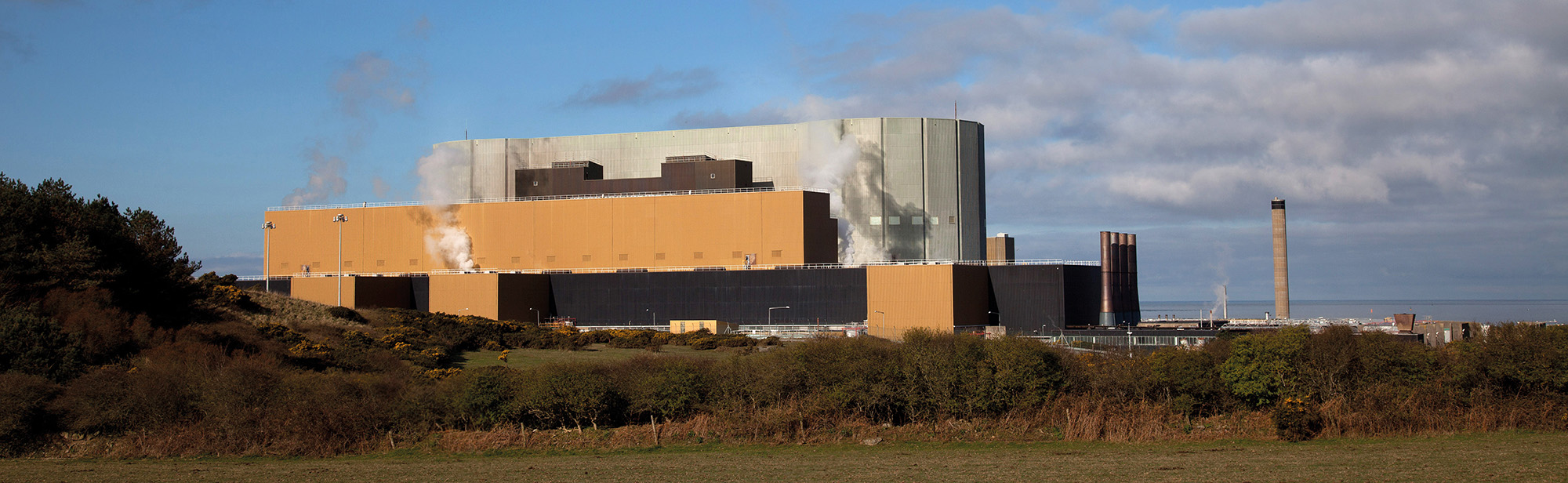
Conclusion
There are no low-energy high-income countries. Britain’s reliance on expensive imported gas is not just bad for the climate and bad for industry, it makes us less secure. Britain needs abundant, clean, reliable electricity. Wind and solar will play a vital role in our energy mix in the years to come, but cannot do it alone. Britain needs a source of power it can rely on all year round. In other words, Britain needs nuclear.
The problem is Britain is the most expensive place in the world to build a nuclear power station. Until that is fixed, nuclear’s role in our energy mix will be limited. Britain will have to choose between imported gas or renewables that are expensive at very high penetrations. If the cost of building nuclear fell, it would save us billions on our energy bills over the coming decades.
The good news is we know for a fact that nuclear can be cheaper. France, Finland, and South Korea all build for much less than us. We have built it significantly cheaper ourselves in the not so distant past. Making nuclear cheap is not reliant on technological breakthroughs. It is about tapping into the proven cost reducers like adopting a fleet approach with a programmatic build out.
This will, however, require big changes. Britain’s nuclear regulations are not fit for purpose. Rules designed to promote safety make the safest way to generate power more expensive. Expensive design changes to prevent tiny radiation exposures undermine fleet economics. Uncertain planning timelines and expensive environmental mitigations push up costs too. All of this will need major reform.
There is an opportunity too. Britain’s small modular reactor builders could attract billions in investment from deep-pocketed tech companies who need clean, reliable electricity to power their data centres, if outdated grid rules are fixed.
Get all of this right and the prize is clear. Cheaper bills no longer at the mercy of international gas markets. Cutting emissions at home and exporting technologies that will help the rest of the world follow. Good jobs in communities from Dungeness to Dounreay and a new lease of life for British industry.
Endorsements
“This report not only precisely lays out the issues that make building new nuclear power stations in Britain so expensive, but clearly outlines the bold but deliverable policies needed to address them. Nuclear is not just low-carbon; it is also reliable and provides the essential baseload power that Britain needs alongside renewables. It is not inevitable that Britain pays more than any other country in the world to build a nuclear plant. With the right policies, costs can be brought down without compromising on operational safety or the environment.”
Rt Hon Lord Hunt of Kings Heath PC OBE
Former Minister of State for Nuclear.
“Britain needs growth, but we won’t get that without a lot more cheap, reliable, abundant energy. That means building more nuclear, just like we used to. We ended the decades-long stop-start approach to nuclear in government, starting two new plants and signing off a third at Wylfa. But it’s still too expensive to build in Britain. This timely report by Britain Remade is therefore a must read for anyone serious about making nuclear energy cheaper, faster and easier to build.”
Rt Hon Claire Coutinho
Shadow Secretary of State for Energy Security and Net Zero
“For too long Britain has effectively regulated itself out of access to clean, secure energy. This paper is a wake-up call that lays out a path to put an end to that. If other countries can build nuclear power at half the cost, so can we. Cutting bills, ending our reliance on gas, and securing the energy we need to grow depends on reforming boldly and quickly. The prize is securing the industries of the future and a stronger economy, while the cost of failure is further decades of decline.”
Chris Curtis MP
Co-Chair Labour Growth Group
“Nuclear power is the only feasible way for Britain to achieve energy abundance without driving up carbon emissions. It is expensive but it does not need to be: France and South Korea build nuclear for somewhere between half and a sixth of the price that we do. The recommendations in this report are a huge step towards getting to those lower costs, and any government interested in economic growth should consider them.”
Sam Bowman, Samuel Hughes, and Ben Southwood
Authors of Foundations: Why Britain has stagnated
"New nuclear will deliver jobs, economic growth and energy security, so it's important that we ensure projects can be delivered in the most efficient way possible. This report sets out how that can be achieved through streamlining reforms and taking a more proportionate approach to regulation while keeping the highest standards, helping deliver vital growth for Britain."
Tom Greatrex
CEO, Nuclear Industry Association
"Britain Remade’s playbook shows the UK how to help innovators build; fix the bureaucratic costs and encourage bankable routes to market, then firms like Last Energy will build here at pace.”
Michael Jenner
CEO, Last Energy UK
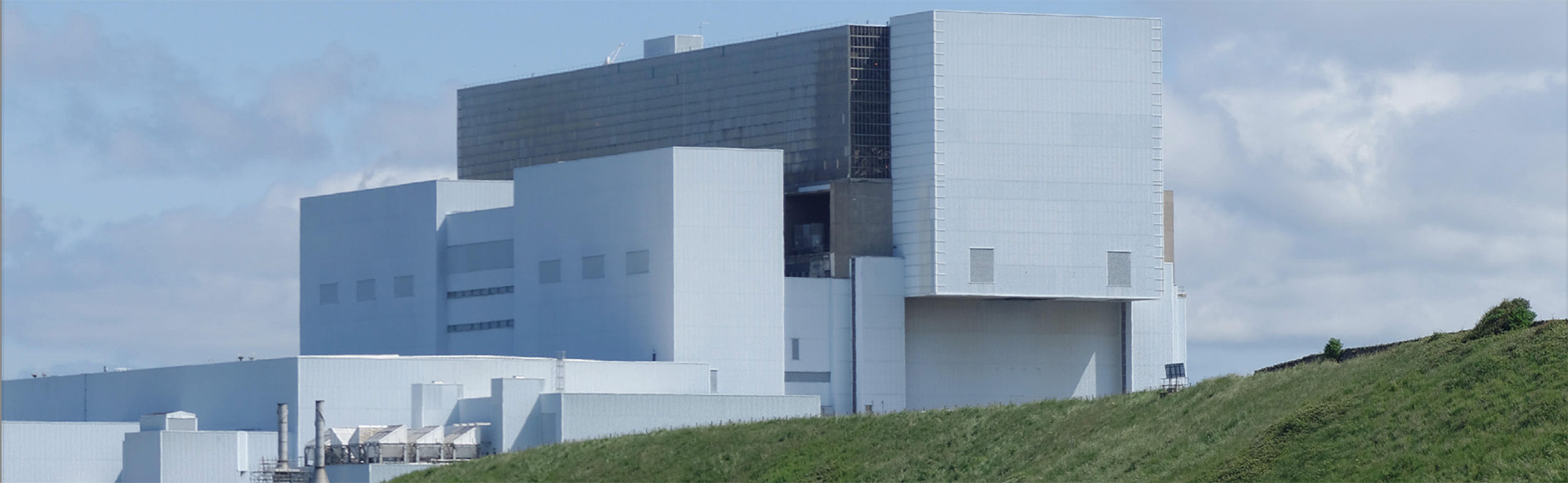
Acknowledgements
Expert Panel
This playbook was informed by an expert panel spanning reactor engineering, nuclear transport, and radiation protection. The panel provided valuable insights throughout, informing the analysis and helping to shape the recommendations. Any remaining errors are the authors’ alone.
- Prof Peter Bryant: CEO, World Nuclear Transport Institute, Professor of Physics at the University of Liverpool and former President of the Society for Radiological Protection, the UKs Chartered Professional Body for Radiation Safety and Radioactive Waste Management.
- Tony Roulstone: Lecturer in Nuclear Engineering at the University of Cambridge and former Group Managing Director of Rolls-Royce Nuclear Engineering Ltd.
- Prof Eugene Shwageraus: Professor of Nuclear Energy Systems Engineering at University of Cambridge.
- Dr Nathaniel Read: Research associate in the Nuclear Energy Group at the Department of Engineering, University of Cambridge.
Acknowledgements
Thank you to the following for sharing their time and expertise to improve this report: Alicia Durham, Adam Bell, Leila Roberts, Robert Boswall, Sam Bowman, Alex Chalmers, Ben Southwood, and Samuel Hughes. All errors are our own.
References
1 Sellafield Ltd. (2016, October 16). 60 years since the day that changed the nuclear industry.
2 Our World in Data. (2025). Nuclear power generation [1966 Dataset]. Our World in Data.
3 Our World in Data. (2025). Nuclear power generation [1974 Dataset]. Our World in Data.
4 Department for Energy Security and Net Zero. (2025). Historical electricity data.
6 This is a conservative estimate and assumes that the emissions intensity of coal would be equal to that of Ratcliffe-on-Soar power station in 2020. Power Station Directory (2025). Ratcliffe on Soar: Carbon intensity Department for Transport. (2025, April 24). Greenhouse gas emissions from transport in 2023
7 Oxford Economics. (2017). The economic impact of Sellafield Ltd.
8 StatsWales. Average earnings data by Welsh local areas. Welsh Government.
9 Department for Energy Security and Net Zero. (2025). Historical electricity data
10 Britain Remade. (n.d.). Tell the government: Don’t switch off clean power in 2029. Britain Remade. Tell the Government: Don't Switch Off Clean Power In 2029
15 Newbery, D. (2021) The cost of finance and the cost of carbon: A case study of Britain’s only PWR
16 Goodlad, D (Undersecretary of State at the Department of Energy), Hansard. (1986) Power stations
17 Mellor, D (Undersecretary of State at the Department of Energy), Hansard. (1982) Power stations
18 Allocation Round 6 for most recent prices, Allocation Round 1 for 2015 prices . Department for Energy Security and Net Zero. (2024). Contracts for Difference (CfD) Allocation Round 6: results and Department Business, Energy and Industrial Strategy (2015). Contracts for Difference (CfD) Allocation Round One Outcome.
20 National Energy System Operator. (2025) 2025 Annual Balancing Costs Report
21 National Energy System Operator (2022) Future Energy Scenarios 2022 & National Energy system Operator. (2025) NESO Clean Power 2030 Report
22 Simmons & Simmons. (2024) What’s the future for Ireland’s data centres?
24Assumes a load factor for solar of 12%, slightly above average for southern England, and a load factor of 90% for Hinkley Point C, fairly typical for PWR nuclear plants. If we assume a relatively dense solar farm, a solar farm outputting as much as Hinkley will need to be 384 square km, slightly larger than the Isle of Wight.
25 E3 Analytics. (2024) Misforecasting the Future
27 2019 figures here: Department for Energy Security and Net Zero. (2019) Contracts for Difference (CfD) Allocation Round 3 results. 2024 figures here: Department for Energy Security and Net Zero. (2024) Contracts for Difference (CfD) Allocation Round 6 results
28 Our baseline scenario uses the Future of Energy Security Scenarios 2025 which are ultimately derived from: Electricity generation costs 2023. These DESNZ figures assume that large scale solar prices will fall 18% compared with Allocation Round 6, . While possible it is also possible that this does not come to pass, hence our modelling of scenarios where renewable costs rise 30% above this baseline.
29 Singh, Arj. (2025, June) HS2 bat tunnel farce worsens as costs rise to £125m. iNews
30 80,000 pages includes supporting documentation.
31 EDF Energy. (2025) Acoustic fish deterrent
33 Paik, S., & Schriver, W. R. (1980). The effect of increased regulation on capital costs and manual labor requirements of nuclear power plants. The Engineering Economist, 26(3), 223-244.
36Nuclear Regulatory Taskforce: interim report. (2025). Department for Energy Security and Net Zero.
37Maconachie,R. (2024). ‘We miners die a lot’: Appalling conditions and poverty wages – the lives of cobalt miners in the DRC. University of Bath and Sturmes,D.. (2023). The fatal toll of artisanal cobalt mining continues. Fair Cobalt Alliance
38 Lukiv, J (2025) Chile rescuers find body of last trapped miner – five confirmed dead. BBC.
39 As many as ten times more are estimated to have died from knock-on impacts such as declining food production.
40 Ritchie, H. (2020). What are the safest and cleanest sources of energy? Our World in Data.
41 Bryant, P. A. (2024). Airborne Radioactive Discharges and Human and Environmental Health Effects. IOP Publishing.
43 Some parts of the UK receive higher doses, for example background radiation in Cornwall is around three times higher than the average, due to the natural presence of rocks with uranium that emit radon..
44 Thomas, G. Public and non-nuclear stakeholders’ perception of the role of nuclear power in climate change mitigation. Imperial College London.
48 UK Health Security Agency. (2023) Radioactivity in Food and the Environment (RIFE) reports
50 Thomas, G. Public and non-nuclear stakeholders’ perception of the role of nuclear power in climate change mitigation. Imperial College London.
51 Ibid.
52 HPC Consortium. (2011, July). Hinkley Point C: Article 37 submission.
53 This limit is derived from the International Commission on Radiological Protection (ICRP).
55 Office for Nuclear Regulation. (2017) Nuclear ventilation codes and standards – Hitachi-GE UK ABWR
56 With thanks to Alicia Durham, University of Cambridge for sharing findings from her forthcoming dissertation.
57 Again, we thank Alicia Durham for sharing insights from her forthcoming dissertation.
58 This would be compatible with the International Atomic Energy Association’s requirement for regulatory independence in Insag-17.
60 The ONR’s statutory purposes are: nuclear safety; nuclear site health and safety; nuclear security; nuclear safeguards; and regulation of the transport of radioactive material (Energy Act 2013, c. 32, Part 3).
61 UK Health Security Agency. (2023). Ionising radiation: dose comparisons. GOV.UK.
63 Boswall, R. (n.d.). EN-7, ’Sup D.C., and the mystery variable. Substack.
64 Lorenzini, P. (2016). Nuclear Power: How Environmentalism Lost Its Way. Nuclear News, 34-39.
65 Bryant, P. A. (2024). Airborne Radioactive Discharges and Human and Environmental Health Effects. IOP Publishing.
68 EDF Energy. (2025.) Acoustic fish deterrent
70 Dumitriu, S. Britain is a consultation nation. Notes on Growth.
71 Sizewell C. (2022, September 28). New ICM poll reveals strong local support for Sizewell C. & BBC News. (2010, October 12). EDF survey shows support for Hinkley power station.
73 Howard, C. (2025). Project Nutcracker – avoiding more kittiwake hotels and bat sheds. HSF Kramer.
74 Latif-Aramesh, M. (2025) How much protection does a National Park or National Landscape need? TLT LLP.
75 Data Centres says max of 22 TWh of electricity needed by 2030. With 6 GW of data centre capacity assuming normal utilisation rates of 65-80% would require between 32-42 TWh of electricity.
76 Ofgem. (2023) Ofgem launches policy review on reforming the electricity connections system.
77 Assumes a continuous 75 MW load (a common hyperscale range is 20–100 MW). Annual consumption: 657 GWh. UK price: manufacturing electricity, Q2 2024, 18.2 p/kWh (DESNZ, Quarterly Energy Prices). Virginia comparator: average industrial electricity price 9.03¢/kWh, May 2025 (EIA Electric Power Monthly, Table 5.6.A).
80 World Nuclear News. (2025, May 9). New supply agreement expands Talen-Amazon partnership.
82 Calculated as (strike − baseload market reference price) × capacity × capacity factor × 8,760 hours/year. Using 100 MW, 90% capacity factor, and the 2024 baseload Market Reference Price of £83.27/MWh (the simple average of LCCC’s Summer 2024 and Winter 2024 values), a £150/MWh strike gives (150 − 83.27) × 100× 0.9 × 8,760 ≈ £52.5 million a year. Low Carbon Contracts Company. (2024). Market reference prices (Summer and Winter 2024 tables).